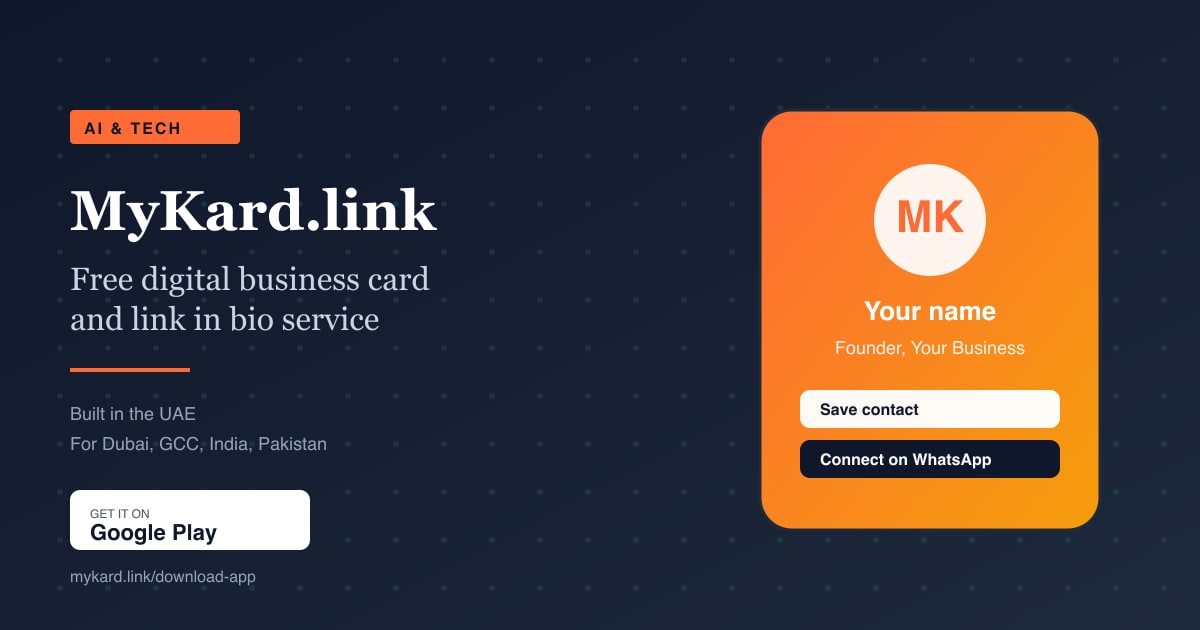
Business cards have been printed in the GCC for fifty years and they still keep arriving in branded boxes of a hundred. Most of those boxes end up in a drawer. A founder hands out twelve cards at GITEX, gets two introductions back, and reorders the rest a year later. MyKard.link, a free digital business card and link in bio service built in the UAE, is one of the cleaner local answers to that drawer problem.
The product is straightforward. You sign up at mykard.link, claim a username, and within a minute you have a public profile page at mykard.link/@yourname that carries your photo, role, business, links, and a saveable contact card. Anyone with a phone camera can scan your QR code and add you to their address book without typing a single character. There is no Apple Wallet pass to manage, no separate vCard file to email, and nothing to install if the recipient does not want to.
Free at the level most people actually need
The base tier is genuinely free, not a 14-day trial. You can publish one card, customise it, share it through the bottom-sheet share menu (QR first, then copy link, WhatsApp, and the usual socials), and collect inbound scans. For a freelance designer in Karachi, an SME founder in Dubai, or a sales agent in Mumbai, that is the version most people will use indefinitely.
A paid Pro tier exists for users who need a second card, want to remove the "powered by" footer, or care about analytics. The Pro pricing is set at AED 29.99 a month and AED 299.99 a year, which keeps it within range of a single coffee at a Dubai cafe and is not the point of this article. The point is that the free tier is a complete product on its own.
An Android app, and an iPhone web app that works the same way
MyKard ships as a native Android application on the Google Play store, available at mykard.link/download-app. The same page walks iPhone users through the two-tap Add to Home Screen step that turns the progressive web app into something that looks and behaves like a native install on iOS. No App Store review queue, no install size, and identical features on both sides.
The download page is the canonical place to send a new user. It carries the Google Play badge, the iPhone home-screen instructions, and the QR code that opens the app on the device that scanned it. For business teams handing out cards to staff, that one URL is the fastest onboarding step.
Where it fits in the GCC and South Asian market
Digital business cards are not a new category. Blinq, HiHello, and Popl have all chased it, mainly out of the United States and Australia, and they all start to feel expensive for users in the UAE, India, or Pakistan as soon as you cross the free-tier limits. MyKard was built locally with that price gap in mind. The infrastructure runs on Cloudflare, the support inbox sits inside Dubai working hours, and the team understands the WhatsApp-first sharing pattern that dominates business introductions across the Gulf and South Asia.
For users in India and Pakistan, the value is the same with two extra reasons. Printing colour business cards in Mumbai or Lahore is cheaper than in Dubai, but the cards still get lost, and a digital card paired with a WhatsApp share link skips the cost entirely. For users who travel between Dubai, Karachi, and Delhi on work, a single QR code on the back of a phone case works the same in every airport.
A link in bio that is not just for influencers
The same MyKard profile doubles as a link in bio page. The default block list covers website, WhatsApp, email, phone, LinkedIn, Instagram, X, YouTube, TikTok, Calendly, and a generic custom-link block. That is the standard Linktree feature set, with one difference: the contact card sits at the top of the page, so a scan from Instagram bio reaches an introduction, not a list of links.
For a UAE solopreneur who runs a small consultancy and a side YouTube channel, that single URL replaces three separate pages. It is also indexable, so the public profile becomes a thin SEO surface for the user's own name.
Things to watch before you commit
No product is perfect, and a few honest trade-offs are worth knowing. The free tier is one card per account, which is fine for most people but limiting for an agency that wants every employee on a single dashboard. Custom domains are on the roadmap rather than live today, so the public URL stays on mykard.link until that ships. And the iOS experience, while functional, is a progressive web app, not a native App Store install, which a small share of users will care about.
None of those are deal-breakers for the core use case. They are the kind of trade-offs that come with a free, regionally built tool, and they are visible up front.
Getting started
Sign up at mykard.link, install the Android app from mykard.link/download-app, or add it to your iPhone home screen using the same page. The free tier is enough for most users; the Pro upgrade is there when the work outgrows it. For more business and AI tool coverage across the region, see our AI and Tech section.