A quiet shift is happening in how creators get paid for referrals. For years, affiliate income meant waiting on a monthly bank transfer from an affiliate network, often with a $50 or $100 minimum payout, currency conversion losses, and a 30 to 60 day reporting lag. In 2026, a growing number of platforms are routing the same commissions through USDT, paying within minutes of a sale, and lifting the headline commission rate well past what the old networks offered.
The structure is simple. A creator, an influencer, a WhatsApp group admin, or a Telegram channel owner shares a unique referral link. When someone buys through that link, the platform credits a commission to the creator's USDT wallet, usually on BSC or Tron, within minutes of the purchase. There is no monthly invoice and no bank in the middle. For creators in the GCC, South Asia, and Africa, where bank-based affiliate payouts have always been the friction point, the change matters more than the technology suggests.
The commission rates are also moving up
Traditional affiliate networks pay between 4% and 10% on most consumer purchases. The newer USDT-paying programs sit at 10% to 20%, often split across two levels: a higher direct commission on people the creator refers, and a smaller indirect commission on people those referrals bring in next. The two levels added together is the headline number creators advertise on their channels.
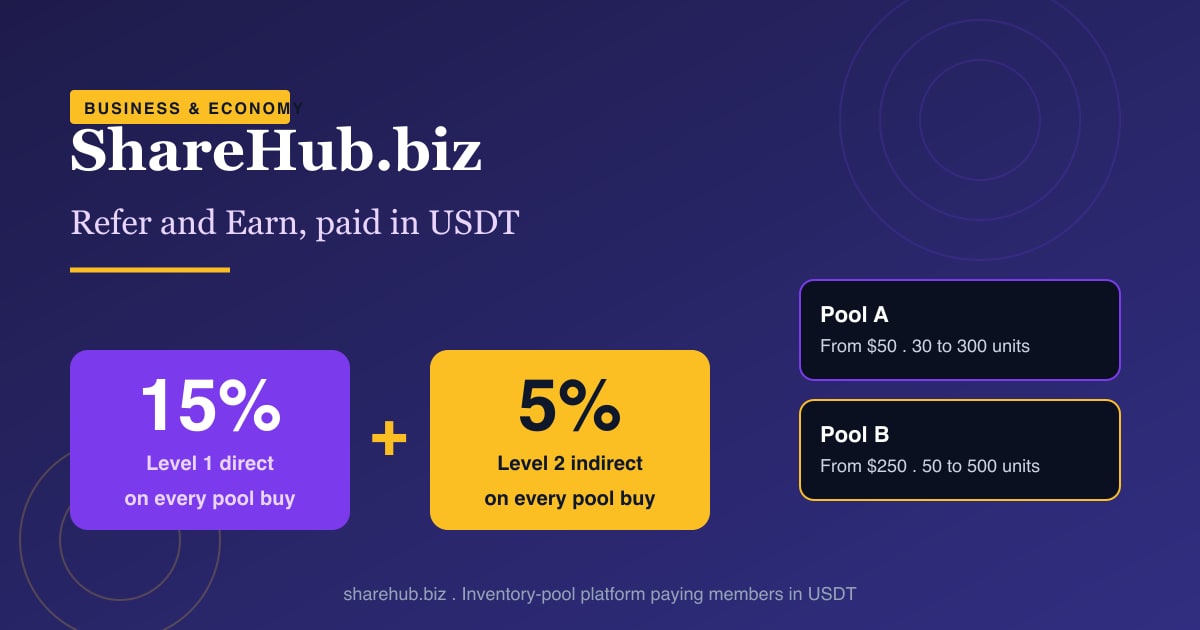
A clear current example is ShareHub.biz, an inventory-pool platform whose members buy into a pool of real consumer goods sold across Amazon, Walmart, Noon, Sam's Club, Carrefour, and Shopify. ShareHub pays creators 15% on every pool buy made by someone they directly referred (Level 1) and 5% on every pool buy made by people those referrals later bring in (Level 2). Added together, that is up to 20% of the pool volume flowing through a creator's network, paid in USDT, funded by ShareHub on top of the buyer's purchase rather than deducted from it. The mechanics are documented in detail at sharehub.biz/how-it-works and in a worked-example post titled Your Network Becomes Your Net Worth.
A worked example, in plain numbers
Say a creator refers one person, Hamza. Hamza later refers two of his own contacts, Riya and Ishaan. That is a normal two-layer network.
- Hamza buys a $1,000 plan. The creator earns 15% of $1,000, which is $150 credited within minutes.
- Riya joins through Hamza and buys $500. The creator earns 5% of $500, which is $25.
- Ishaan also joins through Hamza and buys $500. The creator earns another $25.
Total commission to the creator on that single round: $200 in USDT, paid by the platform, with nothing coming out of the creator's own pocket and nothing deducted from the buyers. As long as the referral attribution is in place and the buyers complete a real purchase, the credit fires automatically. ShareHub members can verify each credit inside the dashboard under Referrals, Earnings history.
What the underlying product actually is
Affiliate programs only matter if the underlying product is real. ShareHub runs two live pools today, with two more launching soon. Each pool is a real inventory bundle that an operating partner restocks and sells through the retailers listed above. Members part-own the inventory and receive a per unit profit credit whenever a unit sells.
- Pool A starts at $50, holds 30 to 300 units, and books a per unit profit of $0.55 to $0.65 based on past sales.
- Pool B starts at $250, holds 50 to 500 units, and books a per unit profit of $2.00 to $2.30.
There is no fixed return promise and no calendar-based payout. What members earn follows what actually sells through the partner retailers, which is the same volatility creators sharing the link should be transparent about with their own audience.
Why USDT payouts change the calculation for creators
Three things make USDT-based affiliate programs travel further than legacy ones across the UAE, Saudi Arabia, Egypt, Pakistan, India, Bangladesh, Nigeria, Kenya, and Ghana. First, payouts are denominated in USDT on BSC or Tron, so a creator in Lagos and one in Lahore see the same balance with the same fee profile, without being routed through a local bank. Second, the minimum withdrawal is typically $5 to $10, which is a real number for first-time creators in any of those markets, not a token threshold. Third, payouts arrive within minutes of a sale, which makes the relationship between content posted and income earned visible the same day.
For creators already running a Telegram channel, a WhatsApp business circle, an Instagram reel-led audience, or a YouTube niche channel, USDT-paying referral programs slot in beside existing offers without the typical "you need ten paid signups first" recruitment gate.
Things creators should be honest about
None of these programs guarantee a return. Affiliate commissions only fire on completed purchases; a link shared with audiences that do not buy pays nothing. The underlying product matters more than the commission rate; a high commission on a thin offer reflects badly on the creator who promoted it. And as with any USDT-denominated income, creators are responsible for their own tax position in their local market.
For a closer look at the specific program above, see ShareHub's explainer at sharehub.biz/how-it-works and an independent writeup at The Finsider. For more business coverage across the region, see our Business and Economy section.