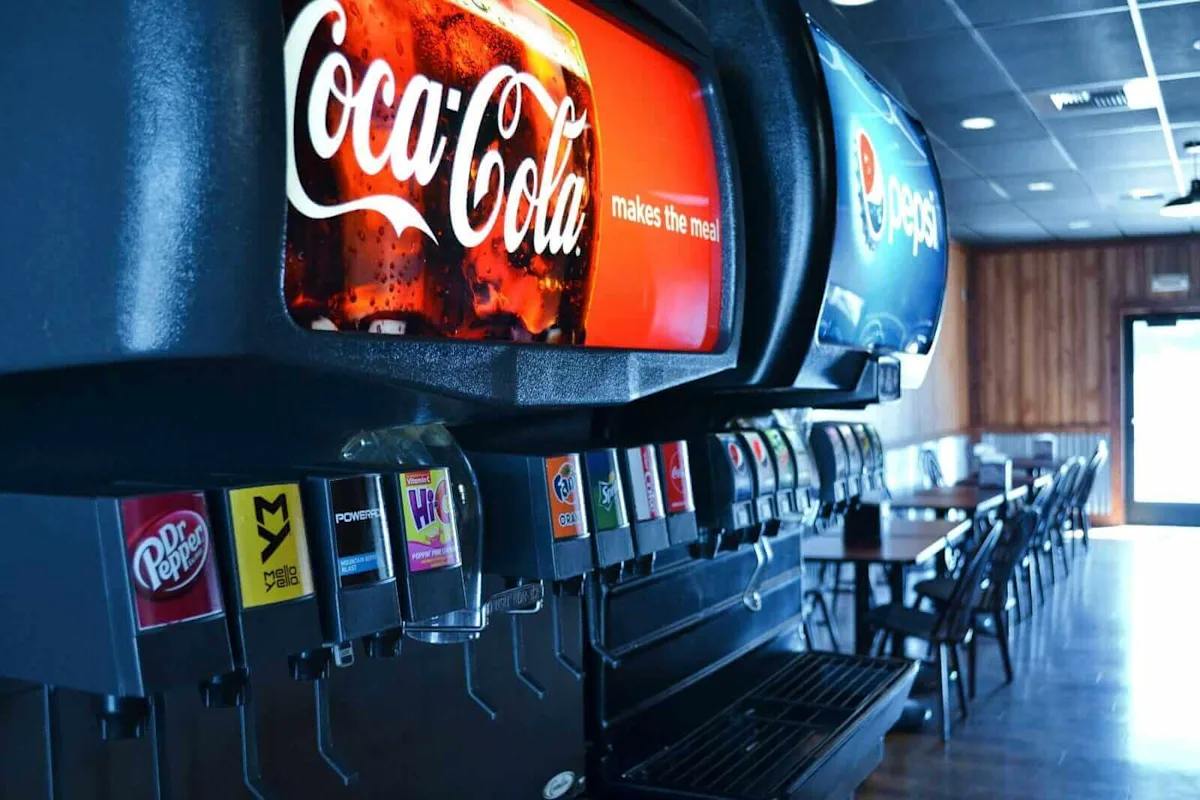
I still remember the cola wars, where Pepsi and Coca-Cola took swipes at each other through marketing campaigns, television commercials, and competing product launches. Today, these two stand as giants in the industry, and yet, the rivalry continues.
But did you know this rivalry extends to their stock prices and, more importantly, their dividends? Right now, given the recent tech decline, these two are attracting renewed attention. But of course, there can only be one clear winner.
So let’s have a look at both companies and compare their fundamentals to see which one is the best choice for your income portfolio.
In the red corner, we have The Coca-Cola Company, or just Coke for short. Coke is a beverage company that needs little introduction. It manufactures and distributes carbonated soft drinks, juices, sports drinks, bottled water, tea, coffee, and energy drinks. 2.2 billion drinks from its signature brands are sold in over 200 countries, each and every day. The result is a company with a market cap north of $346 billion.
Today, the stock is trading at $80, slightly below its all-time high of $81.09 reached on Feb. 1, 2026.
Performance-wise, the stock is up 14% in the last year, 15% year-to-date, and around 11% in the last month.
Now, some investors might be wondering if they’d be buying at the top if they choose Coca-Cola. Well, to them I say, it’s not really about the price, but about the long-term return. Plus, we’ll see later what analysts have to say about the stock’s potential upside.
And in the blue corner, we have PepsiCo: a beverage and food company that manufactures its popular Pepsi soda, in addition to some of the most well-known snack brands like Lay’s, Doritos, Cheetos, and more. PepsiCo also owns the Quaker Oats Company, a more nutrition-focused food brand. The company has a market cap of just over $231 billion, making PepsiCo the smaller contender, at least by market cap.
At the time of publication, PEP stock trades around $167, about 15% below its all-time high of $196.88. Meanwhile, the stock is up 10% over the last year, 17% year-to-date, and about 15% in the last month.
It’s fair to say that both dividend stocks are trading higher, at least right now, on the back of recent bullish momentum and sector rotation. However, PepsiCo is sitting a fair way away from its all-time high, while Coca-Cola is sitting right below it. Does that mean PepsiCo is cheaper? Or maybe investors shouldn’t buy Coca-Cola? Well, I wouldn’t draw conclusions so quickly. That said, if you are averse to buying stocks near their highs, then PepsiCo might look more appealing.
To determine whether a company’s stock is worth buying, investors need to understand how the business actually operates.
Coca-Cola operates in a more asset-light model. That means the company uses minimal capital to maximize profits.
In Coke’s case, it owns the brands and produces concentrates and syrups, which are then sold to independent bottlers who handle the rest of the distribution to consumers. The company dubs this network the “Coca-Cola System.”
So what does this mean, exactly? Since the company focuses only on syrup production and partnerships, it tends to have higher margins and more predictable cash flow, three things that dividend investors absolutely love.
On the other hand, PepsiCo has a more vertically integrated model. That means it owns much more of its manufacturing, logistics, and distribution facilities. Right off the bat, it requires more capital investment and upkeep, though it does offer the company better control over its production and quality and, of course, higher revenue by sheer dollar amount.
But that doesn’t mean it’s more profitable. Let’s check the numbers to be sure.
Here’s a quick rundown of both companies’ latest annual numbers (FY ‘25).
Metric
PepsiCo
Coca-Cola
Comment
Revenue
$94 billion
$48 billion
PepsiCo is nearly 2x larger by revenue. Both grew 2% YoY, but Coke has stronger 5 year growth at 45% vs 33%.
Net Income
$8.2 billion
$13.1 billion
Coke earns far more profit despite half the revenue, showing much stronger profitability.
Profit Margin
8.7%
27%
Massive gap. Coke runs a significantly more efficient, asset-light model.
Operating Cash Flow
$12 billion
$7.4 billion
Pepsi generates more total cash flow due to scale, about 63% higher than Coke.
Capital Expenditures
$4.2 billion
$2.1 billion
Pepsi spends roughly double on capex, reflecting its heavier operating structure.
Free Cash Flow
$7.7 billion
$5.3 billion
Coke converts a large portion of operational cash flow into free cash flow after capex.
As we can see, Coca-Cola has a more efficient business model, though PepsiCo wins on sheer numbers alone. But how does that affect the dividends?
Coca-Cola pays a forward annual dividend of $2.04 per share, yielding around 2.5%. The company has also increased its dividends by 24% over the last five years and currently has a 68% dividend payout ratio. For those unfamiliar, the dividend payout is the percentage of a company’s earnings it pays out to shareholders.
Coca-Cola is also a Dividend King, having increased its payouts for 64 consecutive years.
On the other hand, PepsiCo pays a higher dividend of $5.69 annually, translating to a yield of around 3.4%. The company also increased its dividends by 40% over the last five years and has a payout ratio of 69%. And as it increased its dividends for 54 consecutive years, PepsiCo is also a Dividend King.
As you can see, both companies are committed to strong shareholder value, though differences in their business models are again reflected in their payouts. Coca-Cola has more modest yields and growth but a longer history of increases, while PepsiCo offers higher yields and faster growth but is a full decade behind on the increase streak.
A consensus among 24 analysts rates Coca-Cola a “Strong Buy” with an average score of 4.67 and a high target price of $89, suggesting there’s as much as 11% potential upside from here.
Analysts are more tepid with PepsiCo, however, with a consensus among 22 analysts rating the stock a “Moderate Buy.” The average score is 3.64, and the high target price is $191, suggesting 14% upside if reached.
Now, I have to admit that when I said there is a clear winner in Coke vs. Pepsi, I technically lied.
Don’t get me wrong, there’s still a clear winner. However, that winner will depend entirely on you, your trading goals, and your risk preferences.
If you’re more conservative and are looking for a more stable, lower-risk choice and are okay with more modest yields, Coca-Cola is your top choice here.
However, if you’re looking for higher yields and faster growth at the cost of slightly more risk, PepsiCo is right up your alley.
On the date of publication, Rick Orford did not have (either directly or indirectly) positions in any of the securities mentioned in this article. All information and data in this article is solely for informational purposes. This article was originally published on Barchart.com