

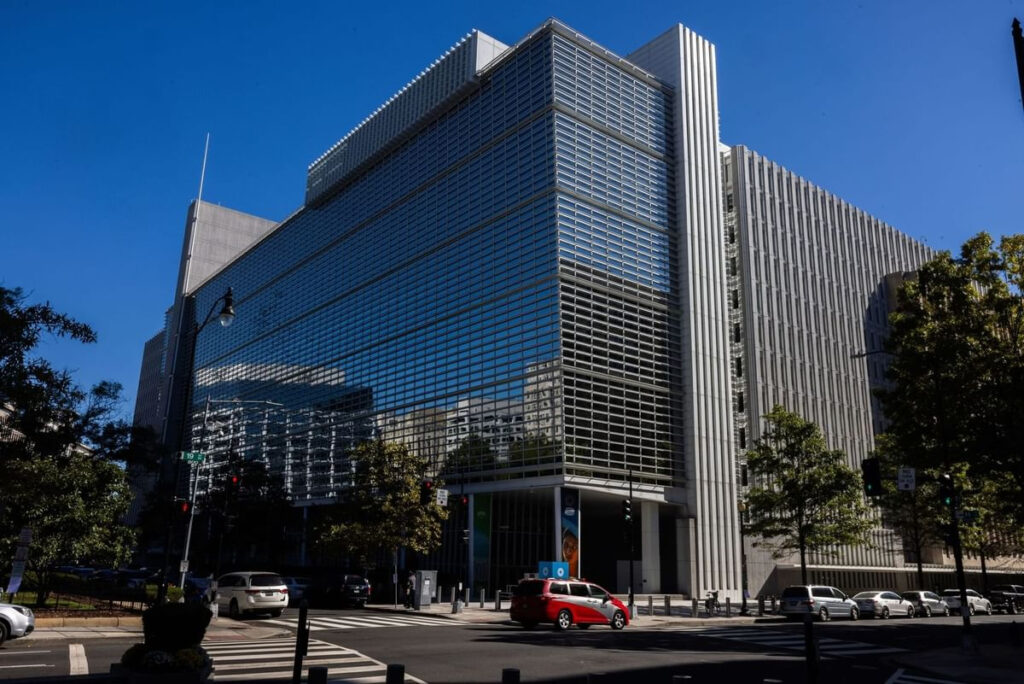
The World Bank expects the UAE economy to grow by 5% in 2026, rising to 5.1% in 2027, according to its latest Global Economic Prospects report released today. The report says the global economy is proving more resilient than anticipated, despite persistent trade tensions and policy uncertainty.
Global growth is projected to remain broadly steady over the next two years, easing to 2.6% in 2026 before rising to 2.7% in 2027, representing an upward revision from the June forecast.
The resilience reflects better-than-expected growth, particularly in the United States, which accounts for about two-thirds of the upward revision to the 2026 outlook. Even so, if these forecasts hold, the 2020s are on track to be the weakest decade for global growth since the 1960s.
The report finds that the sluggish pace of growth is widening global living standards gaps. By the end of 2025, per capita income in nearly all advanced economies exceeded 2019 levels, while about one in four developing economies remained below those levels.
At the regional level, the World Bank projects that growth in Gulf Cooperation Council (GCC) states will rise to 4.4% in 2026 and 4.6% in 2027. Growth in the Middle East and North Africa, Afghanistan and Pakistan (MENAP) region is expected to reach 3.6% in 2026, improving further to 3.9% in 2027.
In 2025, global growth was supported by a surge in trade ahead of policy changes, as well as swift readjustments in global supply chains. These boosts are expected to fade in 2026 as trade and domestic demand soften. However, easing global financial conditions should help cushion the slowdown.
Global inflation is projected to decline to 2.6% in 2026, reflecting softer labour markets and lower energy prices. Growth is expected to pick up in 2027 as trade flows adjust and policy uncertainty diminishes.
“With each passing year, the global economy has become less capable of generating growth and seemingly more resilient to policy uncertainty,” said Indermit Gill, Chief Economist of the World Bank Group and Senior Vice President for Development Economics.
The report expects growth in developing economies to slow to 4% in 2026, down from 4.2% in 2025, before edging up to 4.1% in 2027 as trade tensions ease, commodity prices stabilise, financial conditions improve, and investment flows strengthen.
Growth in low-income countries is projected to be higher, averaging 5.6% over 2026–2027, supported by firming domestic demand, recovering exports, and moderating inflation. However, this will not be sufficient to narrow the income gap with advanced economies. Per capita income growth in developing economies is projected at 3% in 2026, about one percentage point below its 2000–2019 average. At this pace, per capita income in developing economies is expected to reach only 12% of the level in advanced economies.
These trends could intensify the job-creation challenge facing developing economies, where 1.2 billion young people are expected to reach working age over the next decade.
The report says overcoming this challenge will require a comprehensive policy effort centred on three pillars: strengthening physical, digital, and human capital to raise productivity and employability; improving the business environment by enhancing policy credibility and regulatory certainty so firms can expand; and mobilising private capital at scale to support investment.
In addition, developing economies need to bolster fiscal sustainability, which has been eroded by overlapping shocks, rising development needs, and higher debt-servicing costs. A special-focus chapter of the report examines the use of fiscal rules to manage public finances.
“With public debt in emerging and developing economies at its highest level in more than half a century, restoring fiscal credibility has become an urgent priority,” said M. Ayhan Kose, Deputy Chief Economist and Director of the World Bank’s Prospects Group. He noted that well-designed fiscal rules can help stabilise debt, rebuild policy buffers, and improve resilience to shocks, but stressed that credibility, enforcement, and political commitment ultimately determine their success.

