

As wall calendars are replaced and the fireworks smoke dissipates, our colleagues at SmartCompany put together an annual list of startups they’ll be paying close attention to in the year ahead.
The 2026 list includes startups capturing carbon emissions in concrete, making life easier for parents with autistic children, launching rockets into space, and more. Three of them are also led by women founders or cofounders. Here they are.
1. Andromeda

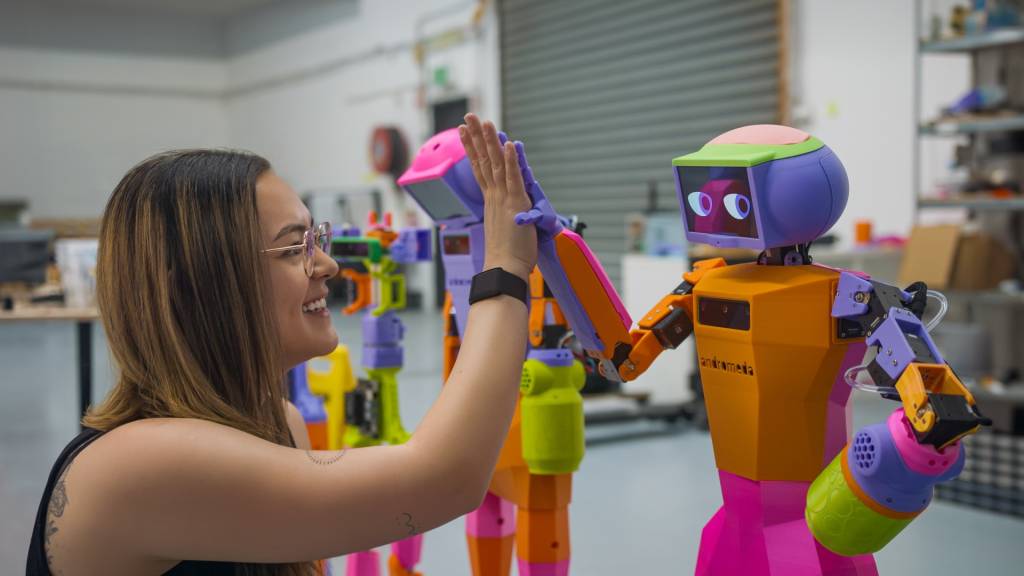
Andromeda founder Grace Brown with an Abi unit. Source: Supplied
Led by founder and CEO Grace Brown, Andromeda is the company behind Abi, a robot designed to reduce loneliness among aged care residents while supplementing human staff.
Earlier this year, the startup secured $23 million in VC funding to fuel its expansion into the US. The deal reportedly valued Andromeda at $100 million. The Series A round was led by San Francisco-based VC firm Forerunner Ventures, with contributions from Rethink Impact, Artesian, Main Sequence, Visible Ventures, Trampoline, and Startmate.
Andromeda previously raised $3 million in 2024.
The company’s Abi robot is AI-enabled and inspired by characters from Disney and Pixar films. According to Andromeda, the Abi units can ‘learn’ from repeated interactions and respond in 90 languages. Aged care facility Mecaware has already deployed these units in 22 of its facilities across the country.
According to Brown, Genesis Abi — Abi’s next iteration — is capable of navigating “the home independently”, if carers provide the humanoid a daily schedule.
Andromeda’s rapid rise also led to Brown gracing the stage at SmartCompany‘s premier edition of the Growth Summit in Sydney in April this year.
2. Lorikeet

Lorikeet cofounders Jamie Hall and Steve Hind. Source: supplied
Australian startup Lorikeet made headlines earlier this year when it beat global heavyweights like Perplexity and Aussie unicorn Canva in a list mapping customer spending in the AI space.
Andreessen Horowitz’s ‘AI Apps 50: Where Startups Spend on AI‘ list, released in October this year, ranked Lorikeet eighth globally for startup AI spend and nine places above Canva, which sat at number 17.
The honour came a month after the agentic AI startup booked a massive $54 million Series A round to expand its universal AI agents for customer service. The investment, which reportedly valued Lorikeet at more than $200 million, was led by QED Investors, with participation from previous backers, including Square Peg, Blackbird, Airtree, Skip Capital, Capital 49ers, Operator Partners and Athletic Ventures.
At the time, the company said its revenue had increased tenfold since October 2024.
Lorikeet, which was co-founded by Steve Hind and Jamie Hall, previously raised $14.4 million in February 2025 and $5 million in October 2024.
Lorikeet’s AI agents, or ‘concierges’, are used by several Australian unicorns, including Airwallex, Linktree and Eucalyptus, as the startup takes on global customer service giants Intercom, Zendesk, Decagon and Sierra.
“Customers don’t want to be told how to fix their problems. They want a concierge that actually solves them,” Hind previously said.
3. Kapture

Kapture founder Raj Bagri
Also on our list of startups to watch is Melbourne-based startup Kapture, as it continues to scale and commercialise its groundbreaking carbon storage technology.
Founded by Raj Bagri, Kapture has developed technology to collect carbon emissions from exhaust fumes and embed them in concrete, as previously reported in a SmartCompany exclusive.
Kapture has also successfully completed a three-month pilot project with Western Australian regional energy provider Horizon Power and partnered with Deakin University’s Recycling and Clean Energy Commercialisation Hub to transform these combustion engine emissions into sustainable fertiliser. Deakin researchers are currently working with Kapture to assess the environmental safety of the material and quantify its value.
Designed to retrofit existing diesel generators, the company’s technology can sequester and store carbon emissions from internal combustion engines, diverting CO₂ from the atmosphere while creating a new, high-quality replacement for traditional cement ingredients.
For every ton of solvent Kapture uses to sequester CO₂ from diesel generators, it claims it can offset between 0.7 to 1.2 tons of CO₂ from being released to the atmosphere during the cement manufacturing process. This is in addition to the reduction in CO₂ emissions from the generator itself.
“As a business, we’re tackling emissions from true sources – diesel emissions – and we’re reducing concrete emissions, and there’s no green premium,” Bagri previously told SmartCompany.
The company’s technology also saw Kapture selected as one of the winners at the Global Construction Startup Competition earlier this year, with founder Bagri then heading to Recotech Finland for the European Pitch Day, where Kapture was the first runners-up.
4. Gilmour Space

Queensland startup Gilmour Space attempted to make history earlier this year when it launched Australia’s first locally made orbital rocket, which crashed 14 seconds after lift-off.
The 23-metre Eris rocket was launched from the company’s Bowen Orbital Spaceport in north Queensland at 8.35am on July 30, 2025, when it briefly soared into the air before veering sideways and crashing back to Earth.
While the launch ended in failure, co-founder and CEO Adam Gilmour described it as a milestone for Australia’s sovereign space capability at the time.
Gilmour Space needed to reschedule its launch on a number of occasions, but it says the launch setbacks have proven to be valuable lessons.
“We’ve learnt a tremendous amount that will go directly into improving our next vehicle, which is already in production,” Gilmour said.
With 2026 on the horizon, we’re looking forward to Gilmour Space’s long road to lift-off finally paying off.
Founded in 2012, the company previously raised $19 million in 2018, $61 million in 2021, and $55 million in 2024.
P.S. When it comes to gender pay gap, Gilmour Space stands out for its unique figures, reporting -3.6% on the median base salary gender pay gap and -3.1% for total remuneration in 2024.
5. Understanding Zoe

Australian startup Understanding Zoe has created a platform to help parents and caregivers with neurodivergent children. And it all started by accident.
The husband and wife duo found themselves as parents grappling with the overwhelming task of managing their daughter Zoe’s autism diagnosis.
“We had degrees and were high-functioning adults and yet we were lost,” Andrac said previously.
After receiving a 35-page diagnosis report and a daunting list of therapies to manage, they began searching for a tool that could cut through the information overload and offer practical strategies in moments of heightened emotion.
When they found there was none available, they set out to build their own. The idea saw Understanding Zoe form a part of Sydney Techstars’ cohort in 2024.
Earlier this year, the startup raised $770,000 (US$500,000) from Verge HealthTech Fund, a leading Singaporean health-tech investment fund. According to the startup, the new funding will be used to build out Understanding Zoe’s offering, delving deeper into the market and funding research.
At the time, Andrac said the funding also validated her own experiences.
“As a neurodivergent, CALD and woman founder, this milestone sends a powerful signal that diverse lived experience and purpose-led innovation can attract meaningful investment,” she said.
“What began with my daughter at our kitchen table is now growing into something that can change the way families everywhere access understanding and support.”
While this list is not an exhaustive view of the innovation taking place in the Australian ecosystem, it goes on to show the wide range of problems local founders are solving. And we’re only more excited to see what the new year will bring to the landscape.
- This story first appeared on SmartCompany. You can read the original here.
