

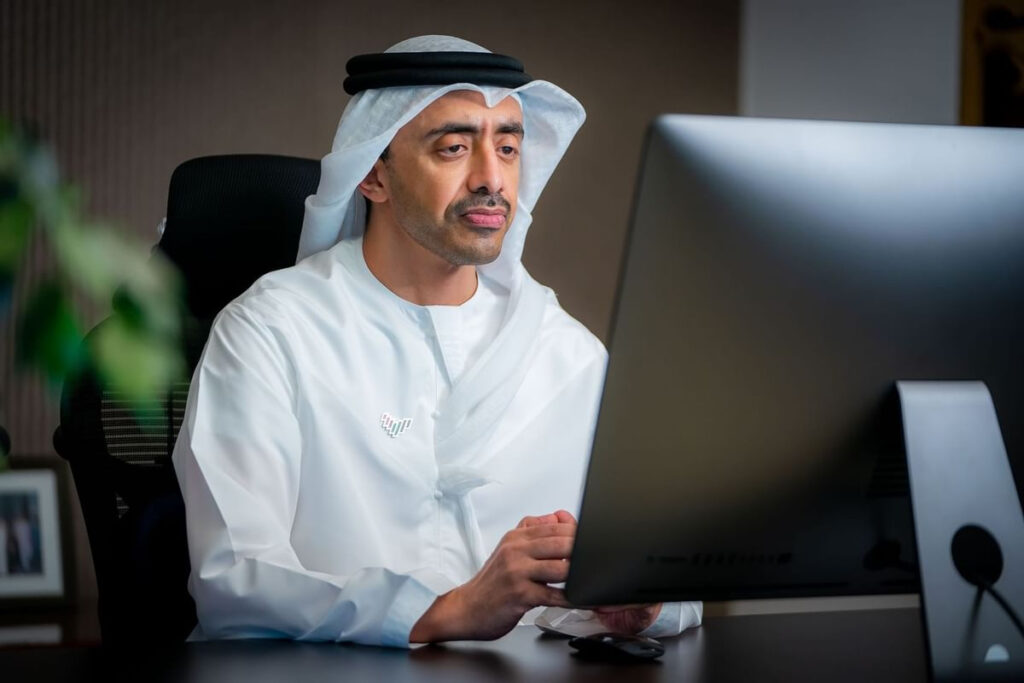
The Education, Human Development and Community Development Council held its second meeting of 2026, chaired by H.H. Sheikh Abdullah bin Zayed Al Nahyan, Deputy Prime Minister, Minister of Foreign Affairs, and Chairman of the Council.
Present at the meeting was H.H. Sheikha Mariam bint Mohamed bin Zayed Al Nahyan, Vice-Chairperson of the Council.
The meeting focused on topics of high priority such as regulating the use of social media by children, promoting robust digital safety measures for children, the development of education policies and curricula, and the results of students’ standardised assessments.
H.H. Sheikh Abdullah bin Zayed Al Nahyan stated that regulating children’s use of social media is a national responsibility that requires the development of clear frameworks. These frameworks, the Chairman emphasised, must match the advanced technological transformations and be solid enough to provide a safe and balanced digital environment for future generations.
He further explained that the proposed direction is informed by a carefully evaluated, phased, risk-based implementation strategy. This approach prioritises social media platforms, given their significant influence and widespread use among children, and incorporates age-based access regulations tailored to the distinct needs and developmental stages of younger age groups. This will allow the balance between leveraging the opportunities offered by modern technologies and safeguarding societal values.
In addition, the Chairman emphasised the importance of the integration of policies related to children, community, and education as this builds the foundation for strengthening family, social, and developmental stability. This integration also promotes generational readiness and supports the country’s long-term competitiveness.
The Council Chairman noted that the real impact of policies is measured by their ability to contribute to the building of confident individuals who are proud of their identity, equipped with the necessary skills, and capable of actively contributing to the nation’s development journey.
During the meeting, H.H. Sheikh Abdullah bin Zayed Al Nahyan underscored the importance of formulating comprehensive national policies grounded in the unique characteristics of the Emirati society. These policies must be responsive to societal needs and aspirations, and adaptable to accelerating global transformations. Such policies should be designed to ensure sustainable impact, enhance quality of life, and strengthen long-term investment in human capital.
Furthermore, H.H. Sheikh Abdullah bin Zayed Al Nahyan emphasised the need to strengthen community awareness and ensure effective integration among stakeholders in regulating children’s use of social media. This includes coordinated engagement across social, technical, educational, security, media, and health sectors to advance a balanced framework that combines appropriate regulation with empowerment and fosters the responsible use of modern technologies.
For her part, H.H. Sheikha Mariam bint Mohamed bin Zayed Al Nahyan said that empowering the family represented a key pillar in addressing rapid digital transformations, noting the importance of equipping families with the necessary tools and knowledge to confidently and responsibly navigate these changes, thereby strengthening their role in guidance, supervision, and fostering healthy digital habits among children.
She explained that regulating children’s use of social media is not only limited to content considerations but also extends to its direct impact on family relationships, the quality of communication at home, children’s engagement in real-life activities, and the potential impact on cognitive development. This includes areas concerning the ability to focus, level of attention, and time management.
H.H. Sheikha Mariam bint Mohamed bin Zayed further emphasised that early intervention during foundational developmental stages is critical to cultivate healthy digital habits, thereby promoting balanced technology use from an early age and mitigating potential adverse effects on behavioral and cognitive development.
She noted that the family serves as the primary reference point for children’s digital conduct, and that achieving balance begins with positive role modeling at home, thoughtful regulation of screen time, and strengthened family dialogue.
Additionally, H.H. Sheikha Mariam bint Mohamed bin Zayed underscored the importance of advancing children’s digital well-being and safeguarding their mental health amid increasing engagement with digital platforms, with the aim of ensuring balanced emotional and social development.
She affirmed that nurturing a well-rounded generation requires strong alignment between schools and families. This must be supported by a value-based framework that reinforces national identity and belonging, while fostering critical thinking and the responsible use of modern technologies.
The meeting, which was held virtually, was attended by Abdulrahman bin Mohammed Al Owais, Minister of State for Federal National Council Affairs; Shamma bint Suhail Al Mazrui, Minister of Community Empowerment; Sarah bint Yousif Al Amiri, Minister of Education; Dr. Abdulrahman Abdulmannan Al Awar, Minister of Human Resources and Emiratisation, and Acting Minister of Higher Education and Scientific Research; Sana bint Mohammed Suhail, Minister of Family; Dr. Sultan bin Saif Al Neyadi, Minister of State for Youth Affairs; Hajer Ahmed Al Thehli, Secretary-General of the Education, Human Development and Community Development Council; Abdulla bin Mohammed bin Butti Al Hamed, Chairman of the National Media Authority; Dr. Mohamed Hamad Al Kuwaiti, Head of the UAE Government Cybersecurity Council; Eng. Majid Sultan Al Mesmar, Director-General of the Telecommunications and Digital Government Regulatory Authority; and Brigadier Dr. Rashid Khalfan Al Dhakhri Rapporteur of the Digital Wellbeing Council.
During the meeting, Sana bint Mohammed Suhail, Minister of Family and Chairperson of the Child Digital Safety Council, presented the latest developments of the national plan to enhance child digital safety in the UAE.
The plan is implemented within a comprehensive national framework led by the Child Digital Safety Council in coordination with relevant entities, aiming to transition from general awareness to an integrated system combining regulation, empowerment, and strengthened community awareness.
She explained that the plan is based on developing a national system for classifying digital platforms according to risk assessment, enabling more effective regulation and ensuring that platforms are subject to proportionate and enforceable obligations aligned with the level of risk they may pose to child safety.
She added that the first phase will focus particularly on social media platforms and age-based access management, given their high influence and widespread use among children, paving the way for a gradual implementation covering other digital services in accordance with risk assessments.
She explained that empowering families is a cornerstone of this path by providing simple and practical tools that enhance parents’ ability to manage their children’s use of digital devices and applications effectively, alongside raising awareness among children and caregivers and promoting safe and responsible use of digital platforms.
As part of the Council’s meeting agenda, Sarah bint Yousif Al Amiri, Minister of Education, presented the latest developments in public education, such as the development and alignment of educational frameworks and policies that contribute to the establishment of a clear national reference for school education. These also define the profile of the learner in the UAE in a way that reflects national identity and aligns with future requirements and leadership aspirations.
In addition, the Minister of Education emphasised the importance of strengthening coherence across all components of the education system, including the national curriculum, assessment and examination frameworks, and strategies for the development, qualification, and empowerment of educational personnel.
She noted that such alignment ensures the integration of policies, plans, and initiatives within a phased and interconnected framework, thereby enhancing the quality of educational outcomes and ensuring alignment with societal needs and national priorities.
She also presented the results of student standardised assessments, including Arabic language evaluation outcomes, underscoring the importance of leveraging them as diagnostic instruments to inform curriculum development and pedagogical strategies.
She emphasised that such data should enable early, evidence-based interventions to address learning gaps and strengthen foundational skills, thereby contributing to the sustained improvement of educational outcomes.
The meeting also addressed updates related to the development of Arabic language and Islamic education curricula, in a manner that supports the strengthening of students’ foundational skills, reinforces national identity and Emirati values, and enhances consistency of content and educational standards across various stages.
The meeting was convened within the broader framework of reinforcing the integration of educational, developmental, and social policies, in alignment with 2026 as the Year of Family. This initiative reaffirms the country’s commitment to strengthening family stability, safeguarding future generations, and advancing sustained investment in human capital and knowledge

