

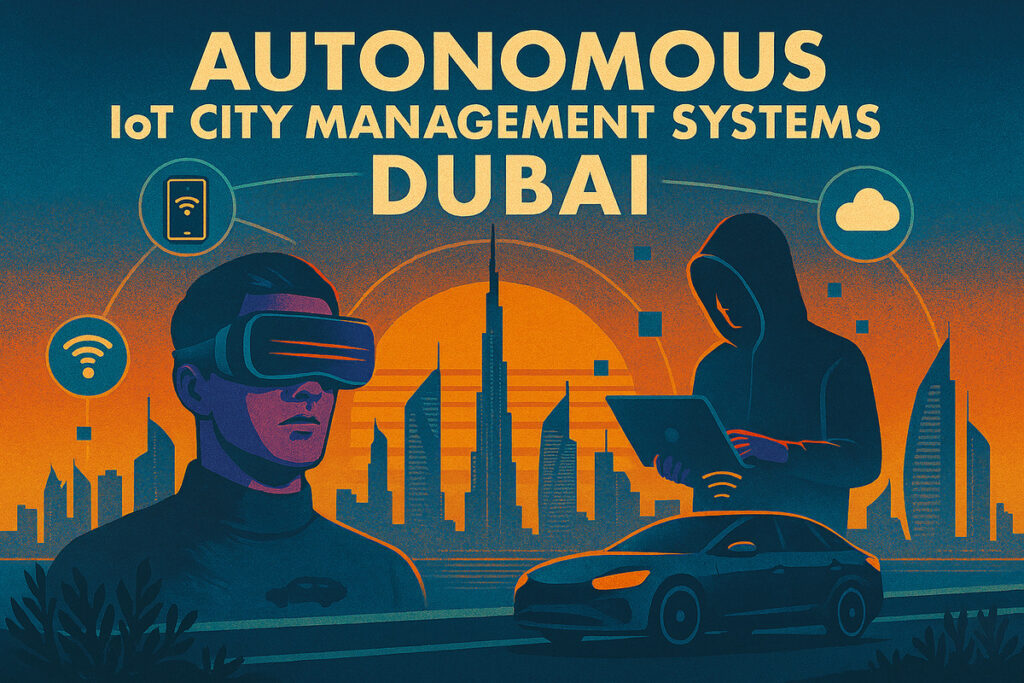
Dubai today is known not only for its impressive skyscrapers, artificial islands, and rapidly growing economy, but also as a city that continuously develops itself in the direction of future technologies and the ideal form of urban life. One of the city’s long-term goals is to minimize human intervention in city management by 2035 and transition into a fully autonomous ecosystem. This vision is not limited to artificial intelligence applications alone; behind it lies a highly complex, expansive, and constantly evolving IoT (Internet of Things) infrastructure.
The aim here is to transform all urban processesranging from traffic flow and energy management to security systems and infrastructure maintenanceinto systems that operate autonomously, can optimize themselves, and even repair themselves. This is not just a technological innovation; it is a modern revolution. In this article, we will discuss Dubai’s 2035 vision. But first, let’stake a look at what IoT actually is. For more information and a wide range of IoT insights, solutions, and product reviews, you can visit the iotonlinestore website.
IoT, or the Internet of Things, is a technology that enables physical devices to communicate with each other and with central systems through the internet. By combining sensors, software, and various other technologies, IoT transforms the devices we use in daily life into smart, connected systems. IoT devices send and receive data over the internet, allowing them to interact seamlessly with one another. They can also operate independently without the need for human intervention. In short, IoT devices are part of our everyday lives, making our world more secure, efficient, and automated.
Dubai’s 2035 vision aims for zero human intervention in city management. This vision is built on three main goals:
- Fully autonomous traffic management
- Self-governing IoT-based infrastructure
- Smart city systems capable of repairing themselves
The ultimate purpose is to create an electronic nervous system across the city—one that functions like a human brain: thinking, analyzing, responding, and repairing itself when necessary.
Autonomous Traffic Management
Today, traffic management around the world still depends heavily on human involvement. But Dubai’s future traffic ecosystem looks entirely different. The planned system includes:
- Vehicles communicating with each other continuously
- Traffic lights making independent decisions based on real-time congestion
- Aerial drones detecting unusual traffic conditions
- Autonomous vehicles reacting much faster than human drivers
When IoT sensors are deployed across every part of the city, they will detect road density, air quality, vehicle types, and emergencies within milliseconds and relay this data to traffic control centers. In the future, all these operations will run without human intervention.
The system will not only collect datait will analyze it, generate solutions, and apply them autonomously.
IoT-Driven Autonomous Infrastructure
Infrastructure is often overlooked, yet it plays one of the most critical roles in city operations. Water pipelines, electrical grids, sewage systems, and communication networks are so essential that even a minor failure can disrupt an entire city.
Dubai’s goal is to turn this entire system into a fully autonomous network capable of managing itself. This means an infrastructure that can:
- Analyze its own condition
- Detect wear and tear
- Report performance drops
- Predict when and where maintenance is needed
All without the need for human oversight.
Self-Repairing Smart City Systems
Perhaps the most futuristicand most excitingpart of Dubai’s vision is the concept of an infrastructure that repairs itself. This idea is driven by three core technologies:
- Self-healing materials
Special polymers used in water pipes can automatically seal themselves when cracks form.
Nano-coated road surfaces can perform micro-repairs in response to heat and pressure changes.
These innovations pave the way for materials that continuously regenerate themselves. - Autonomous inspection robots
Miniature robots will constantly patrol sewage tunnels, energy lines, and water pipes.
They will detect issues and carry out simple repairs instantly, preventing major failures before they occur. - Smart energy grids
When an area shows signs of potential failure, energy can be redirected automatically.
Faulty sections are isolated from the system, keeping the rest of the network running smoothly.
All of this takes place without requiring human intervention.
With these systems in place, a city gains something akin to its own immune systemdetecting, responding, and healing itself autonomously.
The Benefits This Vision Brings to the City
Dubai’s zero human intervention goal is not merely a technological showcase; it is designed to solve real, tangible problems. Since failures will be addressed before they occur, service interruptions across the city will decrease significantly. Budgets allocated for maintenance teams, manual inspection processes, and emergency responses will be greatly reduced. Energy waste will be minimized, infrastructure lifespan will be extended, and the city’s overall carbon footprint will shrink.Lastly, in a system free from human error, risks can be managed faster and far more accurately.
In conclusion, Dubai’s bold steps demonstrate how IoT technologies can revolutionize city systems on an urban scale. The goal is not for robots to replace humans, but rather to free people’s time so they can focus on more meaningful tasks. IoT-based autonomous systems make city life more efficient, safer, and more sustainable.
If this vision succeeds, Dubai will not just be a cityit will become a prototype for all future cities. This new model, where human intervention is reduced to a minimum, will reshape the direction of urban planning worldwide. We are taking one more step into the future, and IoT systems are at the heart of that journey.
Contributed by GuestPosts.biz

