
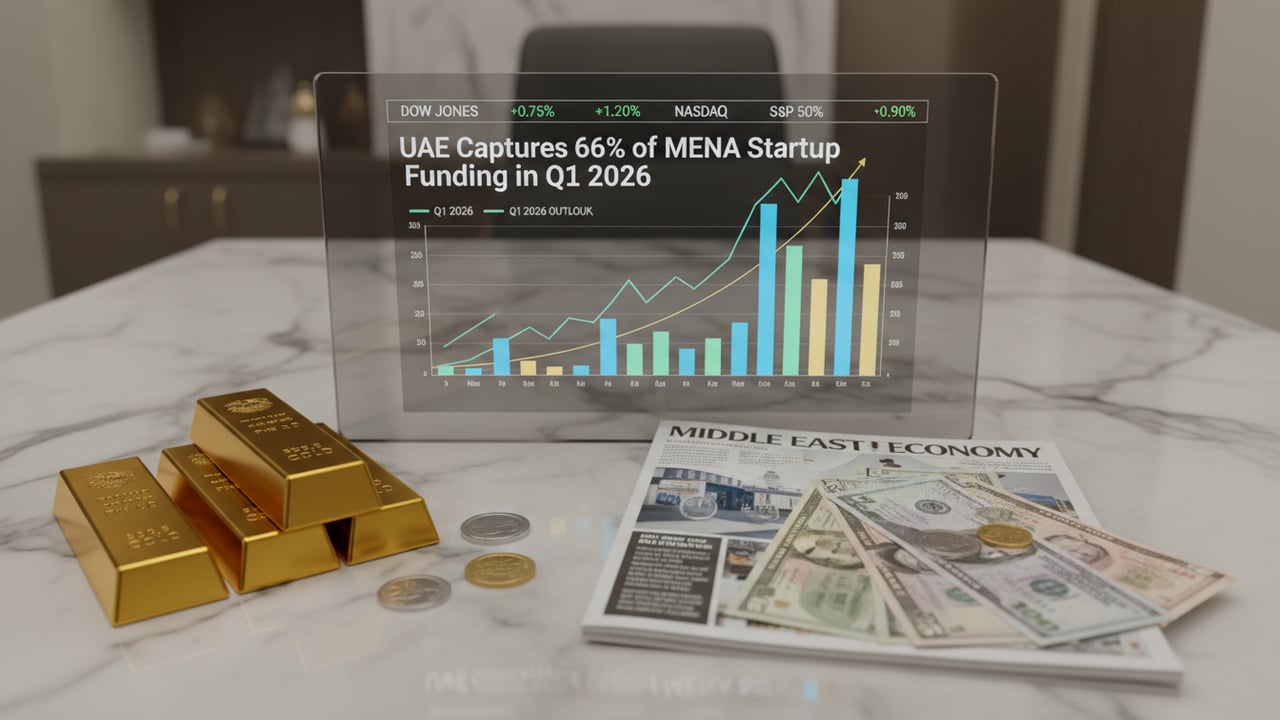
UAE-headquartered startups raised $625.8 million across 46 deals in the first three months of 2026, taking 66.5% of all venture capital deployed across the Middle East and North Africa, according to regional funding data released this month.
That share is a step-up from 2025 and underscores how concentrated MENA's risk capital has become, with founders in Riyadh and Cairo gaining ground but Dubai and Abu Dhabi still attracting the bulk of cheques. Fintech led every other sector, capturing 46% of capital deployed, followed by proptech which attracted $228.6 million across 12 deals.
Where the cheques landed
Payment infrastructure, embedded finance, and B2B fintech solutions absorbed the most capital. Several deals saw the median Series A for Abu Dhabi-based startups settle at $11 million, well above the global average of $6.8 million reported by the same trackers. Late-stage activity remained selective but the willingness of regional sovereigns to lead growth rounds kept the median higher than it would have been in a comparable European or US cluster.
Outside fintech and proptech, the strongest activity came from logistics and AI-tooling startups serving the public sector. Healthcare AI, climate, and creator economy startups raised smaller but more numerous rounds, reflecting a broader trend toward operating-business funding rather than pure consumer plays.
What comes next
The 2026 outlook for UAE funding is more cautious than the headline number suggests. Global startup investment is down year over year and the wider regional pool through April was 87% lower than the same period a year earlier. The UAE's outperformance is therefore as much a story about regional rotation as it is about absolute growth, with Saudi-headquartered startups absorbing a larger share of mega-rounds and Egypt grinding higher off a smaller base.
For founders, the message is straightforward. Capital is available, but it is concentrated in stages and sectors where commercial traction is already visible. Pre-seed remains a harder sell unless the cap table includes a strategic backer or an in-region fund with a sovereign anchor.
For policy makers, the test will be turning Q1's headline share into a more durable pipeline of post-Series A operators. The UAE's free zone licensing reforms, ADGM and DIFC's parallel English-law jurisdictions, and the country's residency permits for founders all remain magnets, but neighbours are catching up quickly on each of those fronts.