

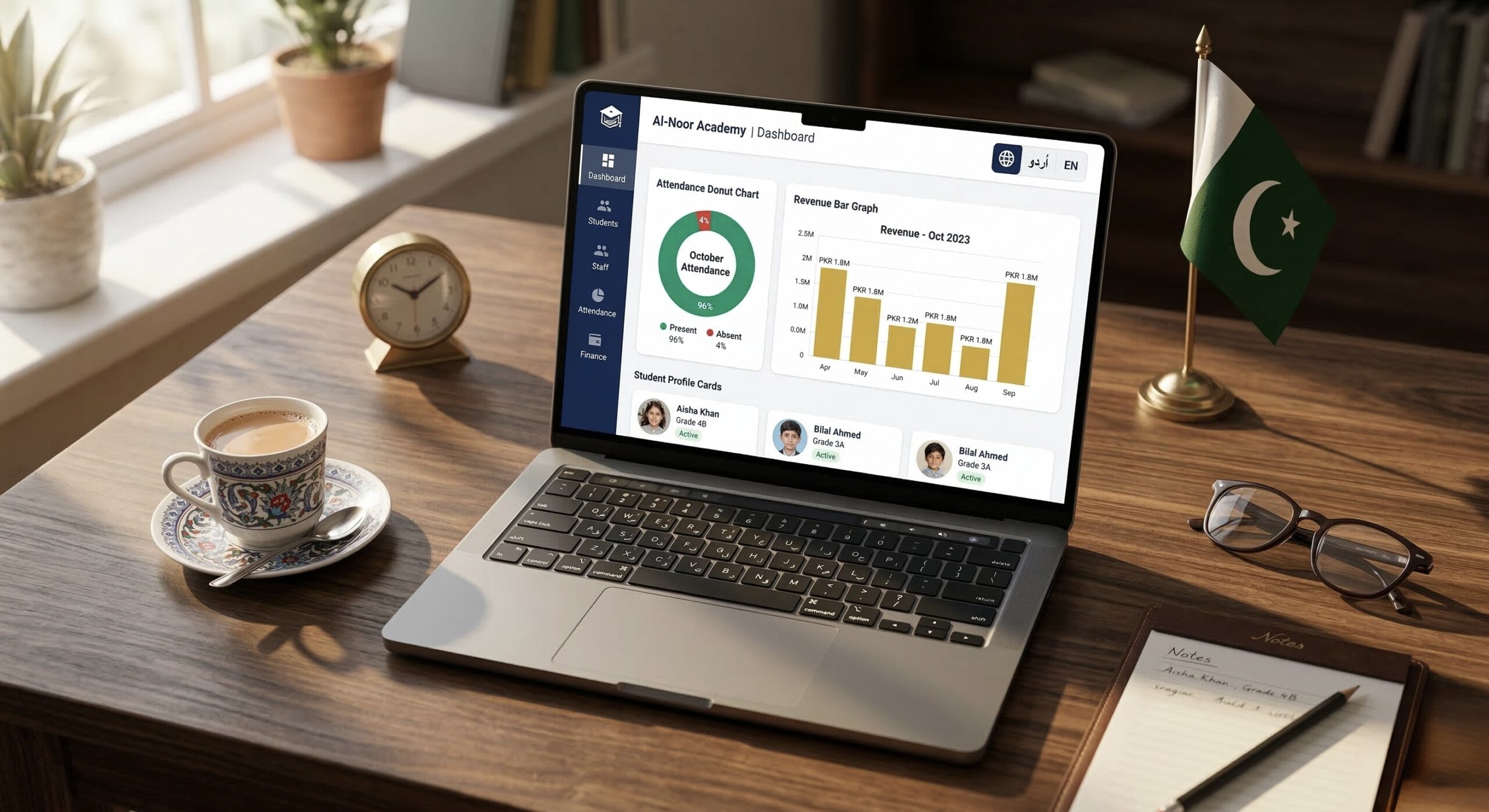
Most of the AI in education conversation in 2026 sits in two places. Either inside elite private schools experimenting with AI tutors, or inside government level pilots that take years to reach a classroom. The harder, less photogenic question is what AI can do for the long tail of small and mid sized private schools that quietly educate millions of children. In Pakistan, a homegrown answer is starting to take shape, and it is called PakEducate.
The real cost of running a Pakistani private school
Walk into any small private school in Lahore, Karachi, Multan or Peshawar, and the daily reality is the same. Teachers spend hours each week marking attendance on paper. Owners chase fee defaulters by phone and WhatsApp. Result cards are typed line by line. Salary slips are written by hand. Most schools cannot afford the international school management platforms that exist, and the few that try them often abandon them because the interface assumes English first staff, modern hardware, and IT support that is simply not there.
The result is a structural problem. Pakistani private schools, which serve a meaningful share of the country’s K-12 students, run on systems that have not changed in decades. The cost is hidden. It shows up as overworked teachers, frustrated parents, and owners who cannot tell at a glance how their school is actually performing.
What PakEducate is doing differently
PakEducate calls itself Pakistan’s first AI powered school management system, and the description fits. The platform brings attendance, fees, results and report cards, salary, expenses, and a free school website into one bilingual dashboard that works in Urdu or English, on mobile or desktop, with no IT setup. According to the company, more than 700 schools and over 200,000 students have already shown interest.
The AI layer is the part most international tools miss. PakEducate’s AI generates student reports, drafts parent messages, and answers admin questions on demand, in Urdu RTL or English. For a school owner in Faisalabad or Bannu, the value of that is not novelty. It is time. Three hours a week of attendance work shrinks to five minutes, in the words of one head teacher quoted on the platform’s site.
The price point that changes the math
The most striking part of PakEducate’s model is pricing. Plans start at PKR 1,500 per month for up to 75 students, which works out to less than PKR 0.67 per student per day. Larger plans drop the number to under PKR 0.50 per student per day. Annual billing comes with three months free. There is no credit card requirement, and a Founding School Offer locks the price for three academic years through March 2029.
For a 300 student school, the platform costs around PKR 6,000 per month. That is less than a single cylinder of cooking gas in many Pakistani cities. At that price, the question for school owners is no longer whether they can afford the platform. It is whether they can afford not to.
Powered by UrduAi.org
PakEducate’s bilingual AI is not a translated layer on top of an English model. It is built on top of UrduAi.org, a Pakistani initiative focused on building serious AI infrastructure for Urdu and South Asian languages. That distinction matters. Most global AI tools handle Urdu poorly, especially in formal school communication where tone, honorifics, and RTL formatting need to be right. By building on UrduAi, PakEducate avoids the awkward, slightly off Urdu that plagues most translated software.
What the early users actually say
The testimonials on the site are specific in a way that suggests they are real. A head teacher at Lahore Model School describes cutting weekly attendance work from three hours to five minutes. A school owner at Al-Noor Academy in Rawalpindi says fee tracking, previously her biggest worry, is now a clear picture. A principal at Islamia Public School in Jhelum says his admin staff started using the Urdu interface from day one without training. None of these are spectacular AI breakthroughs. They are the small operational wins that, multiplied across 700 schools, change the texture of how Pakistani education runs.
The honest caveats
Three things are worth flagging. First, low pricing is powerful but it has to remain sustainable. The team has committed to a three year price lock for founding schools, which is reassuring, with a maximum 10 percent increase after that and 90 days notice. Owners adopting now should still factor in that any platform’s pricing can evolve. Second, AI in school admin is useful, but the same AI in classrooms, with children, raises harder questions about supervision, data, and age appropriate use. PakEducate today focuses on admin, which is the right starting point. Third, dependency on a single platform for fees, attendance, salary, and results means data backup and exportability matter. Schools should ask, and platforms should answer, where data lives and how it can be retrieved.
Why this matters beyond Pakistan
The wider point is that affordable, locally built, language native AI infrastructure is starting to land in places the global AI conversation usually ignores. Pakistan’s private schools are not a small market. They serve millions of students, employ hundreds of thousands of staff, and shape the early years of a generation. A platform that makes their daily operations five times faster, in their own language, at the price of a cup of tea per student per month, is not just a software story. It is a quiet piece of education infrastructure.
If the model holds and adoption continues, PakEducate may end up as the default operating system for Pakistani private schools, the way email became the default for offices. That is a long way off, but the early ingredients are visible: a clear product focus, honest pricing, bilingual AI that actually works, and a market that has waited a long time to be served properly.
