

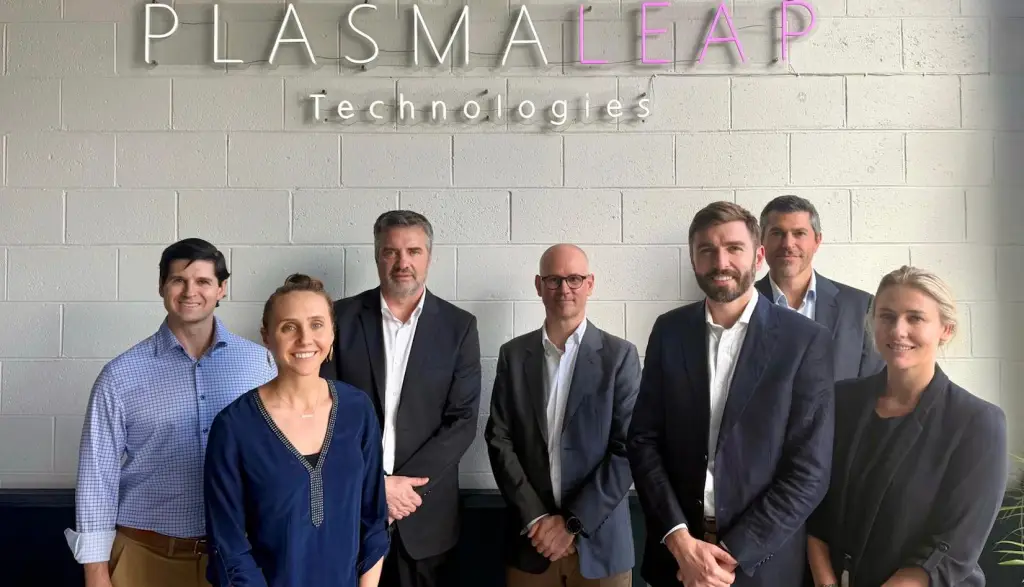
Sydney startup PlasmaLeap Technologies has raised US$20 million (A$28m) in a Series A to reduce carbon emissions in fertiliser and fuel production.
The raise, closed in January, was co-led by the Gates Foundation, Investible and Yara Growth Ventures, the VC arm of nitrogen fertilisers producer Yara International. Additional support came from Twynam, GrainCorp Ventures, Uniseed/UniSuper, Artesian, SVG Ventures and Kiwi fertiliser cooperative Ravensdown’s Agnition Ventures.
The funds will go to first-of-a-kind fertiliser hubs in New South Wales and Tasmania, expanding field trials, and developing PlasmaLeap’s core technology as it looks to support longer-term use in sustainable fuels and energy systems.
PlasmaLeap, founded in 2019 and spun out of the University of Sydney, is developing zero-emissions chemical reactors for synthesis of green fuels and chemicals. They enable farmers to produce sustainable nitrogen fertiliser directly on their farms or at local hubs, to cut emissions, input costs, and supply-chain dependency.
The PlasmaLeap modular reactors produces ammonia and nitrate using only air, water and renewable electricity.
Ammonia is the primary ingredient in most nitrogen fertilisers, a core input for agriculture and worth around $100 billion globally a year. Its production, transport, and application accounts is also a major contributor to carbon emissions.
Food security and stable costs
PlasmaLeap CEO and cofounder Frere Byrne said the support of strategic and institutional investors is validation of both their technology and the opportunity.
“This funding allows us to move from successful trials into real-world deployment, demonstrating how clean, decentralised fertiliser and chemical production can transform agriculture, reduce emissions and guarantee sovereign security of critical resources like food and fuel,” he said.
Byrne said their technology will improve national food security and stabilise input costs for growers, as well as generating high quality carbon credits. There’s also potential to produce synthetic hydrocarbons from biogas, syngas, or other low-carbon feedstocks.
Yara Growth Ventures investment director Stian Nygaard praised PlasmaLeap as a breakthrough platform for fertiliser with lower CO2 emissions.
“We see strong potential for this technology to scale competitively and reduce the climate impact of farming,” he said.
Investible’s Ben Lindsay said they first met the team through the VC’s Greenhouse Tech Hub in Sydney and its tenth investment in a Greenhouse member.
“PlasmaLeap is unlike anything we’ve seen in the green ammonia space and their technology is defining a new category in distributed sustainable fertiliser production,” he said.
The startup is is a grant recipient of The Gates Foundation, the 2025 winner of SVG Thrive, a finalist in Petronas Future Tech 4.0, and a 2024 Australian nominee for the Earthshot prize.
