

There’s been no shortage of startup funding announcements this week, with 10 Australian and New Zealand companies that collectively raised $193.65 million in new funding.
Keep reading to learn more about Neara, Splose, Operata, HAMR Energy, Adora, Fluency, Wellumio, eGuarantee, Contented and Agover.
Neara: $90 million

Leading this week’s funding round-up is Sydney-based startup Neara, which has become the latest private Australian technology firm to be valued at more than $1 billion, after raising $90 million in Series D funding.
The new funding is set to accelerate Neara’s global ambitions for its digital twin modelling technology, which uses AI and machine learning to create 3D digital models of power and infrastructure networks to help better understand how they behave and respond in real-world conditions and scenarios.
The Series D round was led by global growth equity firm TCV, which has previously invested in the likes of Netflix, Spotify and Revolut, as well as local technology firms including Xero, Employment Hero and SiteMinder.
A number of Neara’s existing investors also participated in the round, including Square Peg Capital, Skip Capital, Partners Group and EQT.
Neara has now raised around $180 million in external funding to date, and the latest capital raise gives the company a valuation of $1.1 billion, according to a statement provided to SmartCompany.
It follows a $45 million Series C round in late 2024. In September 2023, Neara added $15.25 million to a $20 million Series B round launched in 2022.
Splose: $46 million

Adelaide-based health tech startup Splose has secured $46 million in a Series A funding round that reportedly values the company at more than $100 million.
According to the South Australian government, the investment represents the largest growth capital round secured by a SaaS business in the state.

Deel wants to give $21 million in global pitching competition, and Aussie founders can apply
It comes several months after Splose founder Nicholas Sanderson was a finalist in SmartCompany’s Smart50 founder of the year category in 2025.
Founded by Sanderson in 2016, Splose offers an all-in-one platform for allied health professionals, including physiotherapists, occupational therapists and speech pathologists, to manage appointments, client onboarding, invoicing and compliance.
The software is used by more than 20,000 individual allied health practitioners in Australia, New Zealand and the UK, with Sanderson telling SmartCompany this week that figure has grown by more than 100% year-on-year.
The Series A funding round was led by US growth equity firm Spectrum Equity and included participation from Australian investor collective Athletic Ventures. It follows a $5 million round led by Sydney-based fund EVP in 2025.
Operata: $11 million

Melbourne SaaS startup Operata has raised $11 million in Series A funding, bringing its valuation to $100 million.
The round was led by Tidal Ventures, with participation from new investor Glitch Capital and existing backers Ghost VC, Black Nova Venture Capital and Flying Fox Ventures.
While the company did not disclose the exact amount raised, a source close to the deal confirmed with amount with SmartCompany.
Founded in 2019, Operara now operates primarily from the US, though its roots and investor base remain Australian.
Operata positions itself as a “CX observability platform” designed to help enterprises understand what is actually happening inside increasingly complex contact centres where humans, AI agents and third-party voice tools now operate side-by-side.
The company argues that the rapid adoption of AI assistants and specialised applications has fractured the traditional “all-in-one” contact centre model, creating a growing visibility gap.
HAMR Energy: $10 million

Australian low-carbon liquid fuels company HAMR Energy has closed a $10 million Series A funding round backed by Airbus, Qantas and industrial firm Thyssenkrupp Uhde.
The funding round was opened in mid-2025 and will now provide fresh cash to advance HAMR Energy’s pipeline of projects. These are focused on converting plantation forestry residues into low-carbon fuels for hard-to-abate transport sectors, such as aviation and shipping.
The investment from Qantas and Airbus has been made through their joint Australian Sustainable Aviation Fuel investment fund, with existing investors also recommitting to the business.
“This funding round is a pivotal moment for HAMR Energy and for Australia’s clean energy future,” said HAMR Energy co-founder David Stribley.
“With the backing of world-class partners, we are advancing projects to deliver the lowest-cost, lowest-carbon fuels to decarbonise aviation and shipping at scale.”
The company’s flagship project, Portland Renewable Fuels (PRF) in regional Victoria, is designed to produce 300,000 tonnes per year of low-carbon methanol using residues from the local plantation forestry industry.
According to the business, that methanol can be used directly as a marine fuel or converted into sustainable aviation fuel (SAF).
Adora: $9.9 million

An AI-powered journey mapping and product insights platform co-founded by Canva’s former head of product has raised $9.9 million (US$7 million) in seed funding.
The round for Adora was led by Blackbird Ventures, supported by Designer Fund, Skip Capital, Co Ventures and Garuda Ventures.
Adora, founded by Omar Salem and Nathan Scully, has already launched with product teams from the likes of Canva, Notion, Replit, Granola and Chess.com using it in private beta, with another 2000 companies on Adora’s wait list to have a crack.
Adora captures every screen, interaction, and user path across a product automatically, so you don’t have to worry about manual event tagging. The platform then creates live visual maps of user journeys, overlaid with analytics and AI-powered usability insights, so teams can see what customers experience.
Salem, Adora’s CEO, said product teams can struggle to understand what their work actually look like in a user’s hands.
“I felt this pain firsthand at Canva, where I led the Product Growth team. The product was in the hands of hundreds of millions of people, from teachers and students to Fortune 500 companies, all with different features and product experiences available to them,” he explained.
“Yet we had no reliable way to understand what experience we were serving each group. We ended up relying on test accounts and screenshots that went stale almost immediately.
Fluency: $8.55 million

Melbourne startup Fluency has raised US$6 million (A$8.55 million) in a Seed round led by US VC Accel, Atlassian’s first external investor.
The raise values the business at around $30m. The cash will help expand the engineering team and support international growth.
Other investors include DST Global Partners (which, along with Accel, was an early Facebook backer), Mixture of Experts, Carya Venture Partners, Archangel Ventures, and NextGen Ventures.
Fluency previously banked a $1.5m pre-Seed round in April last year.
Swinburne engineering graduates and self-taught developers Finnlay Morcombe and Oliver Farnill, both now 25, launched Fluency in 2023. They joined the Swinburne Innovation Studio Pre-Accelerator, winning the Best Pitch Award, then the People’s Choice Award in the subsequent accelerator, and we part of Startmate’s Summer ’25 cohort.
The work intelligence platform captures how work happens across an organisation, using AI to turn it into documentation, alongside outlining automation opportunities, and transformation insights.
Wellumio: $6.2 million

A New Zealand medtech developing a portable neuroimaging device for rapid, point-of-care stroke detection, has raised $6.2 million (NZ$7.28 million) in a first close for its pre-Series A.
The raise so far for Wellumio was led by Nuance Connected Capital, with support from Icehouse Ventures, NZ Growth Capital Partners (NZGCP)’s Aspire Seed Fund, Pacific Channel, Booster, and Cure Kids Ventures.
Angel investor groups Flying Kiwi and Enterprise Angels also chipped in, alongside international investors via the New Zealand Government’s Active Investor Plus (AIP) programme and retail investors through Snowball Effect.
Wellumio is transforming stroke care with its portable brain scan technology, called Axana, to rapidly detect acute stroke and unlock treatment within the critical ‘golden hour’, when every second counts for improved outcomes and recovery.
The new funding will go towards building out the team and capacity, advance clinical development, refining Axana for scalable manufacturing, and ongoing clinical evaluation. The pre-Series A continues.
eGuarantee: $5.5 million

Sydney proptech eGuarantee has raised $5.5 million, with global specialist insurance investor Correlation increasing its ownership stake from 25% to more than 60%.
The raise follows growing adoption of eGuarantee’s digital Lease Bond platform, which is designed to replace traditional bank guarantees for commercial property leases.
According to the company, the total value of bonds facilitated through the platform has grown from $8 million to more than $100 million in less than four years. Over the past 12 months the value of bonds written increased by 338%.
The new funding will be used to scale eGuarantee’s operations, expand landlord acquisition and distribution, and support a planned expansion into New Zealand.
“This capital lets us scale fast to meet surging demand,” Stephen Ellis, executive chairman of eGuarantee, said.
“Real estate is a notoriously slow-moving industry but landlords need to move fast to address antiquated bank guarantees. We are introducing Lease Bonds that cut risk for landlords and unlock cash for tenants.”
Contented: $3.5 million

New Zealand AI work conversations summary platform contented raised $3.5 million *NZ$4.1 million) n a Seed round backed by Altered Capital, with support from Shearwater Capital and Exhort Ventures.
Taking its lead from the likes of Gemini, Otter and other AI meetings note takers, Contented turns meetings, video calls, and other discussions into minutes, health and safety reports, statements of advice, and compliance documentation, focusing on areas such as wealth management, professional services, and financial advice.
The startup, founded by Hannah Hardy-Jones and Lucy Pink has more than 200 customers and bootstrapped to NZ$1.4m in annual recurring revenue, with a Sydney office planned in the next few months.
The funds will go towards product development, trebling the team to 15, and UK and US expansion.
Agover: $3 million

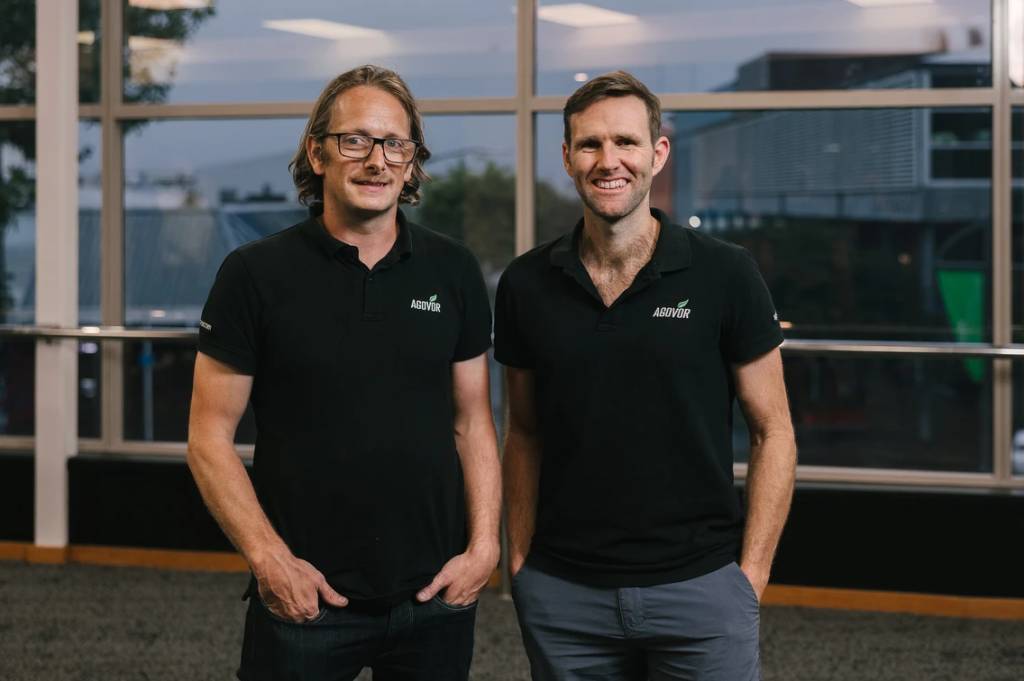
New Zealand horticultural robotics startup Agovor, has raised A$3 million in a pre-Seed funding.
The round has been led by Australian agriculture-focused VC Tenacious Ventures with co-investment from the Hort Innovation Investment Fund, managed by Artesian, and a Kiwi investor via Invest New Zealand’s Active Investor Plus scheme.
Agovor combines an electric, autonomous eTractor with a range of smart towed attachments, including mowers and sprayers. The small, lightweight tractor-and-trailer units can operate for up to 10 hours continuously, including narrow rows and all weather conditions and is designed for vineyards, orchards and berry farms.
Richard Beaumont, who cofounded Agovor with Simon Carroll in 2022, said the idea began as a way to solve problems at their own nursery.
“We had the same problems as everyone else – labour constrained, while trying to reduce costs – but there were too many barriers for adoption of new solutions,” he said.
“We built something that worked for us, and it’s been encouraging to see our first customers across New Zealand and Australia finding the same value, whether they’re working in berry tunnel houses, orchards or vineyards.
Beaumont said their focus following the raise is threefold: “continuing to improve the eTractor itself; expanding the range of towable implements so growers can carry out multiple tasks by simply switching trailers; and helping customers get the most out of these machines on their farms, every minute of the day and night.”
