

As Elon Musk played to his Christ complex overnight, offering sight to the blind, Tesla was killing off the cars that made it successful, the 14-year-old Model S sedan and 11-year-old Model X SUV.
The business that popularised electric vehicles is pivoting to AI and robots as car sales fall, and revenue too.
Just as Tesla’s Q4 results were about to drop, the multitasking CEO was promising that Blindsight, an experimental medical device developed by his brain chip company, Neuralink, is ready to roll and will eventually make people “superhuman” and see like Star Trek’s Geordi La Forge in infrared, ultraviolet and radar.
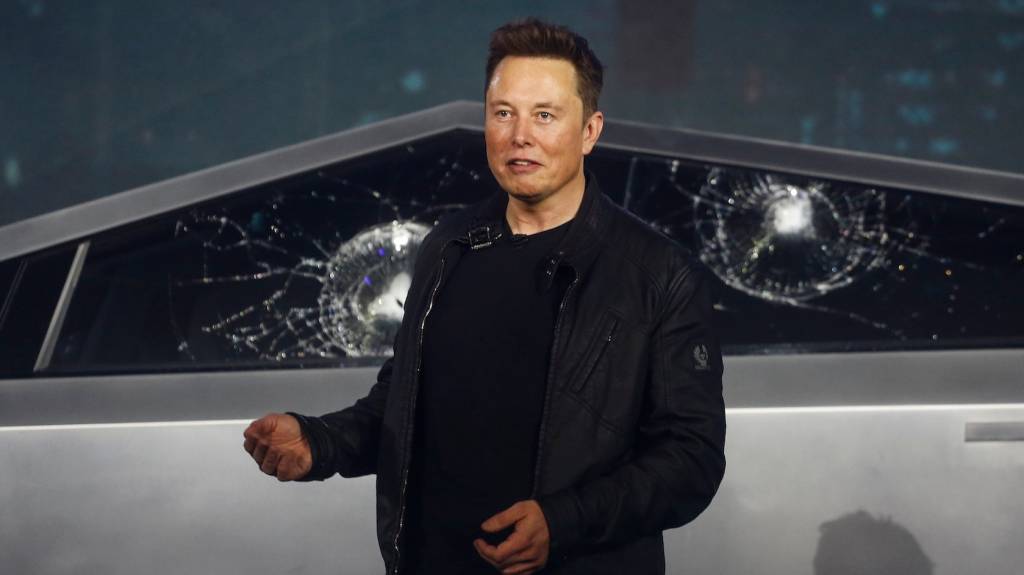
Yet the company that forged his reputation is facing its own mortality around EVs, especially the Cybertruck, a massive flop, with sales halving in 2025 to just over 20,000.
Sales have now declined two years in a row, and Tesla has lost its crown as the world’s best-selling EV maker.
In 2025, China’s BYD In 2025 sold more than 2.25 million EVs. Tesla sold 1.65 million, down from 2024, 1.78m and 2023’s 1.81m.
Another promise broken
The cheap Tesla Musk promised would boost sales in 2025 never eventuated, but it’s worth remembering that Musk kept up the charade that it was coming like the pet shop owner in the Monty Python parrot sketch, even when everyone else knew it was dead.
So Tesla is now betting on robots and autonomy for its future – as well as investing US$2 billion in the CEO’s side hustle, xAI. Perhaps that addresses the 2024 lawsuit filed by Tesla investors claiming Musk diverted the company’s AI talent and resources to his private business.
“We’re making big investments for an epic future,” Musk said.
The world wealthiest orator then revealed: “I guess I have, like, one, I guess, like, it’s not exactly, it’s not exactly bad news, but it’s a, it’s, it’s, we’re it’s, it’s time to basically bring the Model S and X programs to, to an end with an honourable discharge. Because we’re really moving into a future that is based on autonomy, and so if you’re interested in buying a Model S or X, now would be the time to order it.”
Production of both cars will end in next quarter. The good news is it’s not an End of Support moment. You FSD (unsupervised) may one day work.
The decision doesn’t mean anything to Australian buyers – Tesla stopped selling the S and X here a few years back, although you’ll find plenty of used ones on the 2nd-hand market.
From cars to bots
Meanwhile, the California factory producing those cars will be converted into a production line for the long-promised Optimus humanoid robot.
It’s worth remembering that in Musk’s classic time-bending style, the Tesla boss told shareholders in June 2024, that “a thousand to a couple thousand robots “ would be working in the company’s factories by 2025’s end.
This time a year ago, on the Q4 2024 earnings call, Musk said the plan was to build around 10,000 Optimus robots in the next 12 months.
“Will those several thousand Optimus robots be doing useful things by the end of the year? Yes, I’m confident they will do useful things,” he said at the time.
Twelve months on, in Tesla’s Q4 2025 earnings call, he conceded not a single robot is doing anything useful – except perhaps as a prop for investor day presentations.
“We are still very much at the early stages of Optimus. It’s still in the R&D phase,” Musk said.
“We have had Optimus do some basic tasks in the factory. But as we iterate on new versions of Optimus, we deprecate the old versions. It’s not in usage in our factories in a material way.”
But then – stop us if you’ve heard this one before – the Tesla CEO said: “We wouldn’t expect to have any kind of significant Optimus production volume until probably the end of this year.”
In the meantime, Tesla is flatlining, except for its P/E ratio, which sits just under 300x when the car industry average is around 15x. The shares did climb 3% today after the results.

Results beat, but drop
While Tesla beat market expectations on quarterly earnings (50 cents per share) and revenue (US$24.9 billion) estimates, the company posted its first-ever annual revenue fall – a 3% year-on-year decline. Net income fell 61%. Profit plunged 46%.
EV sales fell 9% in 2025. Total automotive revenues dropped 11%.
But Musk is upbeat, saying the new focus “intends to send a message of optimism about the future, like we’re most likely headed to an exciting, amazing era of abundance.”
He may be applying the royal “we” in that sentence, given the compensation package the board offered the world’s richest man.
The good news is that the full-self driving promised every year for over a decade is definitely, almost, nearly, any day now, just about here, Musk said, believing US regulators will approve fully autonomous cars across half the country by the end of 2026.
Robo-taxis – a ship that sailed some time ago, some would argue, with Waymo already setting up in Australia – are also part of the Tesla strategy, along the biggest market bubble since Dutch tulips, artificial intelligence. Perhaps his success with child porn on X has filled Musk with possibilities.
The CEO believes they “make far more Cybercabs than all of our other vehicles combined”.
“I’m just guessing,” he said, “but probably less than 5% of miles driven will be where somebody is actually driving the car themselves.”
He also said: “I feel very confident predicting autonomous robotaxis for Tesla next year.” Oops, sorry, my bad.
That’s a Musk statement from 2019.
The company’s most useful product and now profitable product, solar batteries, are part of a push to supply data centres, along with solar cells.
Tesla plans to spend US$20 billion this financial year on factories for Cybercab, EV semi, solar cells, batteries and robots.
As for the clusterfu Cybertruck, Musk thinks they might be useful for last-mile cargo deliveries in cities.
Or maybe the people will start buying them so ICE officers in Minneapolis have to work much harder to smash car windows.
