

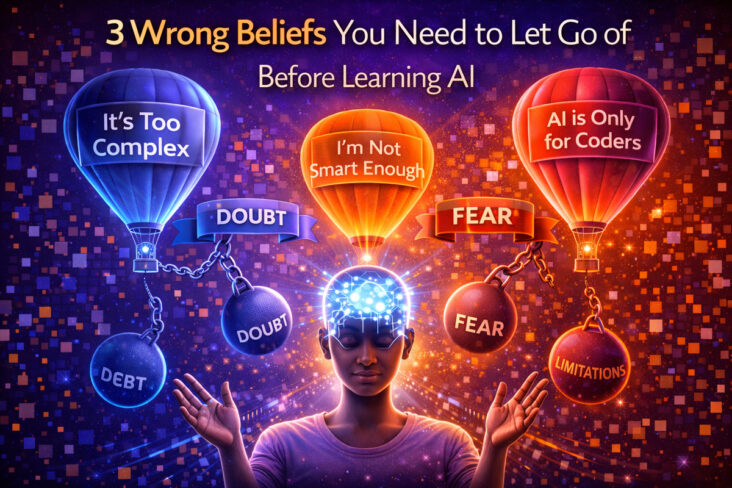

Artificial intelligence has become one of the most talked-about topics in recent years. It is increasingly present in business, education, content creation, and daily life. Yet interestingly, many people who start learning AI struggle right at the beginning, lose motivation, or abandon the process saying, This isn’t for me. The main reason is often not a lack of information, but the wrong beliefs carried in the mind before the learning even begins.
Learning AI is as much a mental process as it is a technical one. If you enter this journey with incorrect assumptions, even the best resources and the most powerful tools will not be enough. In this article, we will examine three common wrong beliefs you need to let go of before learning AIand why they hold you back. If you’re curious to see how this perspective turns into real experience, you can visit The Blue Whale AI Academy.
1. Wrong Belief: AI Is Only for Technical People
This is perhaps the most common and most damaging belief. Many people see artificial intelligence as a field only for programmers, engineers, or those who are very good at mathematics. Those without coding skills or a technical background feel excluded before they even start.
However, today most AI tools are designed for nontechnical users. AI is no longer just about writing code; it is about thinking, asking questions, guiding processes, and evaluating outputs. Marketers, educators, entrepreneurs, designers, content creators, and even students actively benefit from AI.
This belief limits a person’s potential from the very beginning. The thought I’m not technical kills curiosity and the desire to learn. In reality, learning AI requires mental flexibility and a willingness to learn more than a technical identity. Not knowing how to code is not a barrierjust a different starting point.
2. Wrong Belief: I Need to Learn Everything
Many people who step into the world of AI quickly feel overwhelmed. New tools, new models, new concepts appear constantly. At some point, the thought arises: I can’t learn all of this. That’s when motivation drops and the learning process is abandoned.
This belief comes from seeing AI as a massive pile of information. But learning AI does not mean knowing everything. What truly matters is learning what you need, at the right time. Just as you don’t need to memorize every word when learning a new language, you don’t need to know every tool or model to learn AI.
This wrong belief turns learning into a stressful race instead of an enjoyable exploration. People constantly feel behind. Yet when AI is learned step by step and selectively, it becomes simpler. The right question is: Where can AI help me in my life or my work? When you focus on this, the learning process naturally becomes clearer.
3. Wrong Belief: If I Make Mistakes, I Fail
At some point, almost everyone feels uneasy when learning AI. Writing the wrong prompt, getting unexpected results, or producing nonsensical outputs can damage confidence. This fear reduces the courage to experiment. However, trial and error lies at the heart of learning AI.
AI is not meant to deliver perfect results on the first try; it exists to improve thinking. Wrong results show you what you don’t want and how to express your needs more clearly. Someone who fears mistakes can never truly learn AI, because learning requires a safe space for experimentation.
This belief turns learning into an exam. But working with AI is not a performance it’s a process. Making mistakes is not failure; it is a natural part of progress. When this perspective changes, the learning process becomes much more comfortable and productive.
Learning Doesn’t Change Until Beliefs Do
These three wrong beliefs make learning AI difficult before it even begins. For someone who realizes that they don’t need to be technical, don’t need to know everything, and that making mistakes is normal, AI stops being intimidating.
Learning AI is, in many ways, a journey of self-discovery. It reveals how you think, how you learn, and how you deal with uncertainty. When false beliefs are left behind, AI becomes not a technology that overwhelms people, but a tool that supports them.
Before starting to learn AI, the real task is not discovering new tools, but letting go of old beliefs. Because most of the time, what holds us back is not technology itself, but the inner voice that says, I can’t do this. Change doesn’t begin by clicking on a new tool; it begins by noticing that voice in our minds.
Contributed by GuestPosts.biz
