

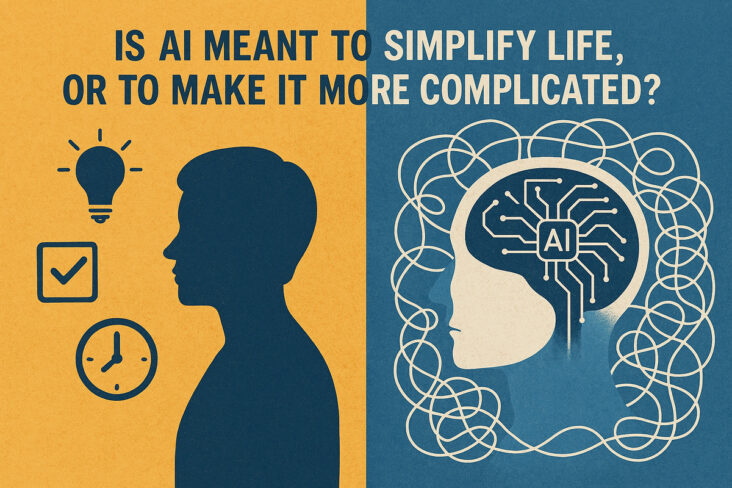

When artificial intelligence is mentioned, most people feel two opposing emotions at the same time: the promise of great convenience and an equally strong sense of complexity. On one side, there are tools that speed up work and help use time more efficiently. On the other, constantly updated systems, endless learning requirements, and the anxiety of Am I falling behind?
So is AI really here to make life easier, or is it unintentionally making it more complicated?The answer does not lie in AI itself, but in how we approach it. By nature, AI is neither good nor bad; neither simplifying nor complicating. What gives it that role is how humans position it. Let’s explore this together. For more details, you can visit The Blue Whale AI Academy.
Where Does the Sense of Complexity Come From?
The feeling of complexity around AI rarely comes from the speed of technology itself. The real issue is how this technology is presented. AI is often described as an allpowerful force that can do everything and must be mastered in every area. New tools, new features, new termsone after another. Inevitably, people start thinking: I have to learn all of this.
This perception turns AI from a helpful assistant into a mental burden. Yet technology exists to reduce human load, not increase it. Complexity does not come from having too much AIit comes from a lack of focus.
What Is AI Actually For?
The core purpose of artificial intelligence is very clear: to make repetitive, timeconsuming, and energy-draining tasks easier for humans. Data analysis, content creation, planning, organizing ideasAI offers serious support in these areas.
However, there is a crucial point to remember. AI does not decide what is important. It does not set priorities. It does not tell you which task truly matters. These responsibilities still belong to humans. If a person does not know what they want, AI cannot provide a clear path. Instead, it may increase confusion by offering more options.
In other words, AI makes life easierbut only when it is placed in the right role.
The Problem Is Not Technology, but the Approach
Many people fall into the same trap when learning AI: I need to learn everything first. This mindset makes the process complicated from the very beginning. Learning without a clear need quickly becomes meaningless.
The better approach is simple: What problem do I have, and how can AI help me solve it? Once this question is asked, technology naturally becomes simpler. Unnecessary tools are eliminated, and the ones that truly add value stand out. AI stops being a burden and becomes a support system.
The Blue Whale Approach: Simplification
This is where platforms like TheBlueWhale make a real difference. The Blue Whale does not present AI with pressure to learn more. Instead, it embraces the idea of learn what is meaningful for you.
The platform does not overwhelm users with long lists of tools. First, it listens:
- Who are you?
- What do you do?
- Where do you struggle?
A learning journey that starts with these questions naturally simplifies AI. Technology is adapted to human life; humans are not forced to adapt to technology. This approach makes AI accessible rather than overwhelming.
Why Is AI Easy for Some People?
Imagine two people using the same AI tools. One experiences increased productivity, while the other constantly feels stuck. Where is the difference?
It lies in expectations. Those who see AI as a magical solution that does everything feel disappointed. Those who see it as a thinking partner adapt quickly. This is the core mindset The Blue Whale teaches: AI does not think instead of youit thinks with you.
Once this perspective is adopted, confusion turns into clarity.
Fewer Tools, Better Use
In today’s world, the problem is not having too few toolsit’s having too many. Every new platform and feature adds learning pressure. Truly efficient people are not those who know every tool, but those who use a small number of tools extremely well.
That’s why TheBlueWhale rejects the learn everythingmindset. Instead, it teaches users how to choose the right tools for their own context and use them deeply. This simplifies AI and makes learning sustainable.
AI is not complexity itself; it is often simply misused. Artificial intelligence is not designed to make life more complicated. What makes it feel complex are our expectations, our learning methods, and our overall approach. When AI is positioned correctly, it reduces mental load, gives time back, and increases productivity.
The Blue Whaleapproaches artificial intelligence from exactly this perspective. It does not glorify technology, nor does it diminish people. Instead of placing AI at the center of life, it places it alongside the human. And perhaps that is why it becomes the platform of choice not for those who find AI confusing, but for those who want to simplify it.
Because in the end, the real issue is not how powerful artificial intelligence is, but how effectively we choose to use it.
Contributed by GuestPosts.biz
