

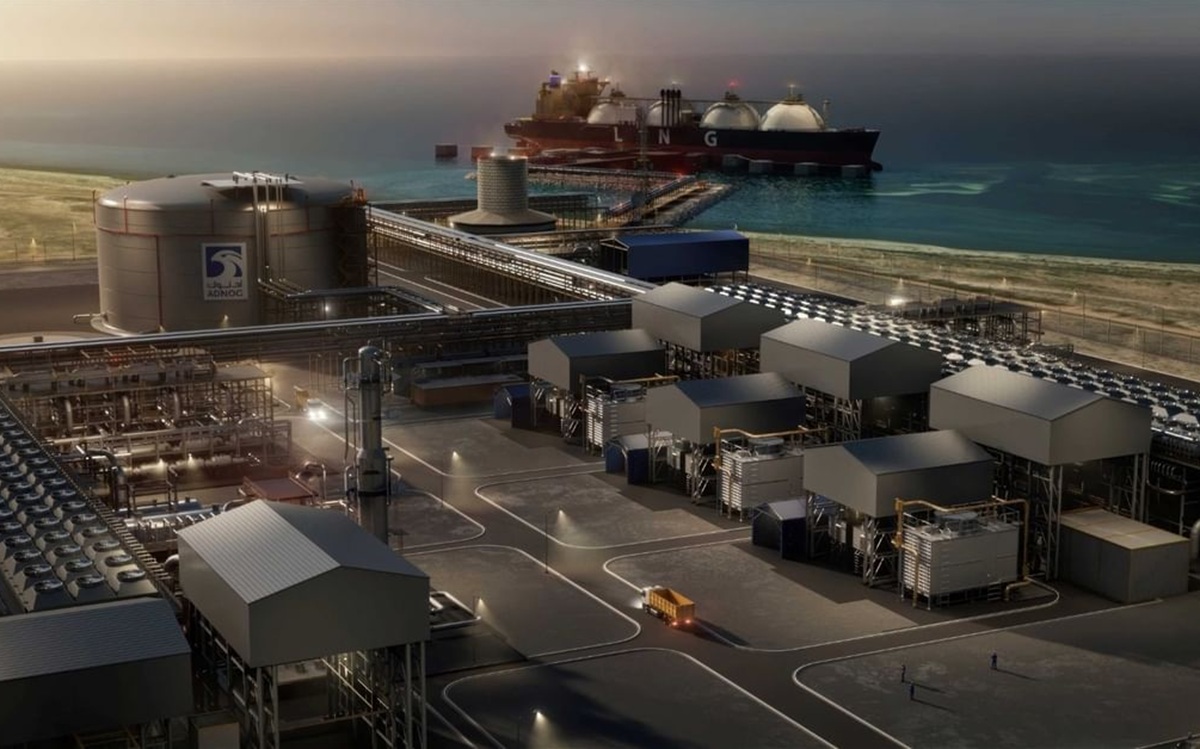
ADNOC Gas is strengthening its position in the global liquefied natural gas (LNG) market as it accelerates delivery of key strategic programmes under an integrated approach focused on operational readiness and long-term asset sustainability.
The company said progress at the Ruwais LNG project continues to advance at an accelerated pace, underscoring its strategic importance amid shifting global energy supply and demand dynamics.
With a planned production capacity of 9.6 million tonnes per annum, ADNOC Gas said construction works at Ruwais LNG are progressing ahead of approved schedules, opening the possibility of bringing forward the start of commercial operations currently planned for the second half of 2028.
Once operational, the project is expected to raise the UAE’s total LNG production capacity to around 15 million tonnes per annum.
ADNOC Gas said it will acquire ADNOC’s stake in the Ruwais project upon completion at an estimated cost of about $5bn.
The company added that it has already secured long-term sales and purchase agreements covering more than 8 million tonnes per annum of the project’s output.
Under its marketing strategy, 80 per cent of production will be allocated to long-term contracts, with the remaining volumes marketed on the spot market, in line with the business model applied at the Das Island LNG facility.
ADNOC Gas expands
ADNOC Gas noted that this approach supports the generation of stable value during the early phases of operation, while acknowledging that global market outlooks remain subject to change depending on prevailing conditions.
The Das Island LNG facility, which has been operating for nearly five decades with a capacity of around 6 million tonnes per annum, completed a comprehensive upgrade programme last year. This included expanding loading jetties to accommodate larger vessels.
The next phase will involve a major refurbishment of trains one and two to maintain operational reliability.
ADNOC Gas reaffirmed its commitment to continued investment in the facility to enhance readiness, while noting that capacity expansion plans are not currently under consideration given evolving global energy markets.
The company added that it is closely monitoring global demand developments, including anticipated growth linked to the expansion of artificial intelligence data centres, which will help shape future priorities between meeting domestic demand and expanding exports.
ADNOC Gas said it has taken proactive steps to address expectations of increased global LNG supply during the second half of this year by securing a number of long-term contracts, particularly with customers in Asian markets.
This strategy is designed to ensure effective marketing of Ruwais LNG volumes and stable returns despite market volatility.
Over the past three years, the company has signed a series of long-term agreements to supply annual LNG volumes ranging between 0.4 and 1.2 million tonnes under contracts lasting up to 14 years.
These agreements expand its customer base and reinforce ADNOC Gas’s position as a leading and reliable global supplier of lower-emissions LNG to fast-growing Asian energy markets.
Liquified Natural Gas reserves
ADNOC Gas also confirmed it is preparing to take the final investment decision on the second phase of the Rich Gas Development project.
The first phase has been progressing according to schedule since its approval in June 2025 and aims to add 1.5 billion cubic feet per day of processing capacity by 2027.
This phase includes a comprehensive programme to debottleneck operations at four key facilities: Asab, Buhasa, Habshan and Das Island.
The second phase involves constructing a new fractionation unit, Train 5, at the Ruwais facility to produce liquefied petroleum gas, condensate and naphtha, while the third phase includes adding a new gas processing train at the Habshan facility.
ADNOC Gas reiterated that its growth strategy follows a clear, phased approach focused on maximising existing production capacity, resolving operational bottlenecks to enhance efficiency, and expanding through new units when required to ensure optimal utilisation of company assets.
