

In more than a decade of covering Australian startups – nearly seven years as Startup Daily editor – one notable aspect of dealing with the sector is unlike any other I’ve encountered in 30 years of journalism.
As LP Hartley wrote in The Go-Between: “The past is a foreign country: they do things differently there.” But that doesn’t mean you’re entitled to erase it.
I get a handful of requests annually to delete old coverage featuring a founder’s previous startup/s. Often, the core proposition is it’s ancient history and doesn’t really matter any more. But the real motivation is often linked to a new startup and due diligence by investors, with founders preferring their past didn’t show up in search.
While startup founders are touted as iconoclastic – bold, brave, defiant, pushing against conventional wisdom to take on the world, defying naysayers and doubters – it’s a sector that punches above its weight in business when it comes to feeling aggrieved about anything less than hagiography in media coverage.
One founder emailed me recently asking that I take down a six-month-old story, alleging it was factually incorrect, even though it contained a quote from them confirming one aspect of the story now disputed. The matter was resolved amicably and in good faith. The story remains online.
But it was a reminder of the startup sector’s common misunderstanding that media is a stenographer of their grand visions.
Startup Daily is overwhelmingly supportive of the tech sector, but if we spot a dickhead, we’ll call it out within the limits of Australia’s strict defamation laws.
Airbrushed
Which brings me to Airwallex and its attempt to airbrush out its past in a legal push to get the Nine newspapers to remove several articles about the Melbourne-founded, Singapore-based fintech published over the last five years.
Mark O’Brien Legal – its eponymous founder’s bio features a media quote declaring him “one of the nation’s most feared defamation lawyers” – wants nine stories based on leaked company documents removed because they are “an indefensible breach of confidence”.
Airwallex, now worth more than 6x the market cap of Nine Entertainment after raising $498 million last month, is moving towards a public float this year.
Keen for a tabula rasa prospectus, perhaps, it appears the company missed the Streisand Effect lessons from Gina Rinehart’s preternatural beauty in complaining about Vincent Namatjira, and when Lachlan Murdoch tried to sue our sister publication Crikey for defamation (later withdrawn).
As one industry observor messaged to me this week: “Do [Airwallex] not have any competent media strategy people? I cannot understand. It’s just so stupid”.
Under the headline “Airwallex demands critical coverage be pulled as it considers IPO” the Australian Financial Review (AFR) reported that the law firm wants Nine, which publishes the AFR and Sydney Morning Herald (SMH), to “permanently remove … the articles and any other articles which contain excerpts of reference to the internal documents”.
“The internal documents are confidential in nature, containing Airwallex’s sensitive commercial information that was not intended for public information,” Mark OBrien Legal principal Paul Svilans wrote.
“Airwallex is aware that you obtained the internal documents from a former employee of Airwallex who was under an express obligation of confidence to Airwallex, and who has given certain admissions to our client in relation to his conduct.”
Harm and damage
The fintech’s lawyer claimed the publishing of the documents caused the business harm and damage.

We are not amused… Airwallex CEO Jack Zhang. Photo: supplied
Perhaps Airwallex would be worth more than $12 billion were it not for stories such as “Airwallex seeking ways around Hong Kong anti-money laundering rules” in 2024, and another in the SMH in 2021 about unhappy staff in company surveys, even if the business promised to do better at the time.
A 2023 AFR story on staff saying mean things about the workplace culture on Glassdoor, the anonymous, publicly accessible employee and rating platform where many go to air grievances about their bosses, was also on the erasure hit list. The complaints were backed up by “internal documents leaked to the Financial Review show staff churn in the three months to September last year was about 10% – 132 people – with the marketing and legal and compliance teams particularly hard hit”, the story said.
Airwallex wants the leaked documents returned or destroyed by Nine.
Mark O’Brien Legal was also upset that details of the letter were publicised, saying it was sent to Nine “on a private and confidential and not for publication basis”, arguing that it did not consent to “release of the content or anything in relation to this letter, including such a letter has been sent to you” and it was “unethical” to reveal it.
We didn’t give you permission to you to reveal we’re threatening you with legal action is not the flex lawyers hope it might be when the media’s natural instincts are free speech and public interest.
An Airwallex spokesperson said the AFR stories contained inaccurate information and the company was “presently considering their legal rights” on that front.
In Australia, unless someone has extenuating circumstances and seeks leave from the courts, you have around 12 months from publication of allegedly defamatory material to begin legal proceedings. And generally, you need to demonstrate engagement with resolving the problems as you see them from the outset, or it’s a bit like leaving an open bottle of champagne in the fridge, then complaining a month later that it’s not bubbly any more.
Perhaps, if Airwallex is looking to lawyer up and have a fight over harm and damage, it could have a crack in US courts at investor Keith Rabois, who told 408,000 followers on Elon Musk’s social media site last year that “Airwallex has become a Chinese backdoor into sensitive American data like from AI labs and defense contractors”. Airwallex CEO Jack Zhang returned fire on social media to deny the allegations, but they were widely reported globally last month and in this humble hack’s view, claiming Beijing has access to your data as an Airwallex customer is far more serious than staff whining that the boss works them too hard.
Meanwhile, it shouldn’t need explaining to most news consumers that leaks are the media’s bread and butter. As the 20th century US media baron William Hearst observed: “News is something somebody doesn’t want printed; all else is advertising.”
But here we are. And the startup sector, over-serviced by the public relations industry, just wants advertising to help drum up interest in their next capital raise or product.
Startups and venture capital firms have felt the lash of critical media coverage in recent years, especially in the AFR. It shocked many to discover that following years of unfettered boosterism while the sector found its legs over the past decade, that the media is not just there as a value add to their expensive PR firm’s company announcements.
As a seasoned startup investor told me this week: “The more you pump out hype and spin, the more you motivate journalists to investigate whether what you say is based on facts. And just because you and an ex-employee (or an ex-investor) don’t like each other any more, doesn’t mean a journalist can’t run a story about their criticisms of you. Journalists serve their audience, not the industry they report on.”
When you control a multi-billion-dollar tech company with a valuation big enough to put you in the top 50 ASX-listed companies by market cap, having raised more than $2 billion from investors, it’s time to put on the big boy pants and expect serious scrutiny. You’re not in Kansas anymore, especially when the business is domiciled in the secretive tax haven of the Cayman Islands.
It’s also worth remembering that publications such as the Nine newspapers have played a crucial role in exposing serious shortcomings in the tech sector.
One of the most egregious was GetSwift, the ASX-listed logistics technology company a Federal Court just described as “representing the unacceptable face of startup capitalism” with “a public-relations-driven approach to corporate disclosure” that torched $104 million in investment, and saw its founders flee the country and fined millions and banned from being directors for 12 years or more.
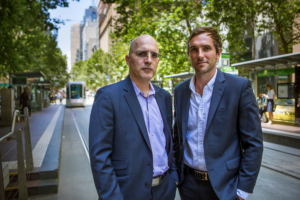
“The unnacceptable face of startup capitalism” – GetSwift cofounders Bane Hunter and Joel MacDonald.
That doesn’t mean the media is mistake-free, gets it wrong or exhibits poor judgment in its criticisms, which it pays for. But part of the critical oversight is a reminder that no billionaire startup founder is infallible on the road to success either.
Under the influencer
Now allow me to share a lesson in picking a fight with the media. If you take the nuclear option, expect a proportional response. The natural instincts of journalists are to keep digging in the face of strong objections from subjects of their attentions.
This week, the SMH ran a story on Airwallex hunting for online influencers they’ll pay to praise CEO Jack Zhang on his “thought leadership” on the B2B influencer marketing platform Partnar.
“Think of this campaign like a documentary clip, not a product ad,” the Partnar pitch says.
“The story is Jack — how he thinks, how he operates, and how he approaches building at scale. Airwallex is simply the backdrop: the global fintech he built, not the hero of the story.
“Creators will share short video clips from Jack’s podcast that highlight his mindset as a founder/CEO. The content should position him as an aspirational operator — calm, thoughtful, and decisive — someone worth learning from, not being sold to.”

The Airwallex pitch on Partnar for people to post about the CEO’s “thought leadership”.
Airwallex is not the only startup/scaleup on Partnar looking to engage influencers to tout their brand, but Startup Daily was unable to find any other pitches where a business is willing to pay for people to pump up its cofounder’s tyres.
So when you return to work after Australia Day, brace for a LinkedIn feed flooded with people praising the Airwallex boss as “an aspirational operator — calm, thoughtful, and decisive — someone worth learning from, not being sold to”, and know you’re being sold to and the people saying it were paid to do it by the fintech.
Ironically, that move may also generate additional news coverage for Airwallex should consumer watchdog the ACCC decide to take a closer look at disclosures involving the campaign.
As ACCC deputy chair Catriona Lowe said in 2023: “Influencers and brands may break the law if they do not take reasonable steps to ensure consumers are not misled to believe that sponsored posts are genuine”.
It’s the sort of thing that may inspire a fresh round of lawyers issuing demands for content to be removed. You can bet the media will cover that too.
