

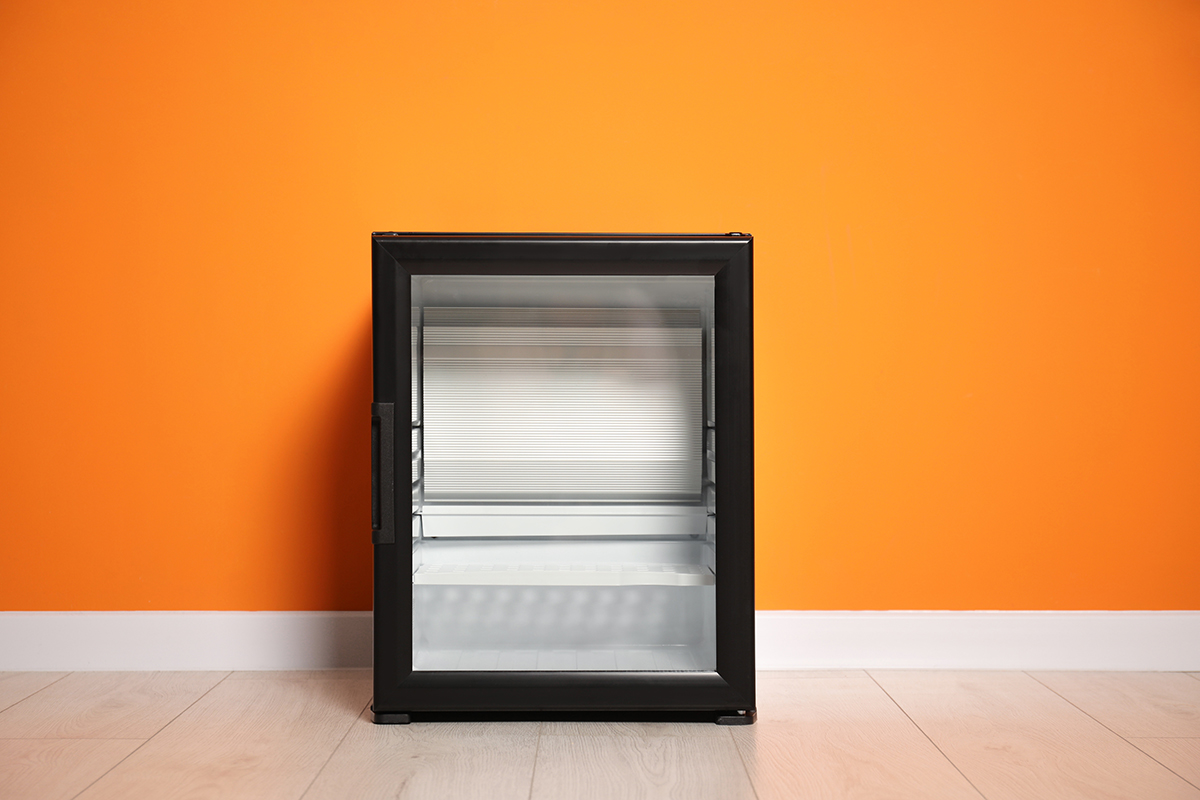
There was a time when hotel minibars felt indulgent. In the Gulf today, they feel like a product that has missed several memos about how people actually live. I did not set out to think about minibars at all.
The thought arrived uninvited, prompted by a menu picked up by accident and a raised eyebrow that stayed raised.
I was staying in a hotel in one of the Gulf’s major cities (it does not much matter which). The prices were enough to stop me mid-glance. Crisps at 55 riyals. Mixed nuts at 75 riyals. Smoked almonds at 75 riyals. A can of Coca-Cola for 30 riyals. M&M’s for 70 riyals. I put the menu down, not out of irritation, but instinct. The calculation was already complete. Only then did I realise I had mistaken the minibar list for the room service menu. The confusion felt appropriate.
In Gulf cities built around instant delivery, the minibar now sits awkwardly outside the rhythm of everyday life. Hotel minibars have always been expensive. Their survival appears to owe less to demand than to habit. They remain in place because hotels have never quite stopped to ask whether they still serve a purpose. They are kept almost by reflex, folded into an unexamined checklist of what a hotel room is supposed to contain.
Living in Dubai, and spending time regularly in Riyadh and Doha, on-demand delivery barely registers as a decision anymore. It is background behaviour. Food, groceries, pharmacy items, late-night snacks, electronics, chargers. Orders are placed casually, often without standing up. Delivery arrives in 10 to 40 minutes, and sometimes even faster. This is treated neither as indulgence nor innovation. It is infrastructure.
The numbers reflect this shift clearly. Online food delivery revenue in the UAE is projected to reach $1.87 billion in 2025, with steady growth expected through the end of the decade. Nearly a third of residents already use meal delivery services regularly, while grocery delivery continues to expand as quick commerce becomes embedded into daily routine.
Saudi Arabia’s delivery apps market is forecast to more than double to $17 billion by 2030, spanning food, groceries, pharmacy and a widening range of on-demand services. Qatar has embraced the super-app model, bundling shopping, subscriptions and lifestyle services into a single digital ecosystem. These figures matter because they describe behaviour, not aspiration.
Gulf consumers are digitally fluent and acutely price-aware. This is especially true of business travellers, the very group hotel minibars were originally designed to monetise. They know what things cost. They know what brands they prefer. They know how long alternatives take to arrive. They also travel frequently, compare experiences constantly and notice immediately when something feels outdated.
So when a business traveller opens a minibar and finds a handful of generic snacks priced far beyond market reality, the response is predictable. Disbelief comes first. Mild amusement often follows. Irritation is not uncommon. A purchase is rare.
Delivery platforms succeed because they offer relevance, from recognisable brands and dietary preferences to local tastes and genuine choice. The minibar, by contrast, offers a narrow, static selection presented as convenience, even though convenience in the Gulf now means something else entirely. This is one of the world’s most distinctive markets for on-demand delivery.
At this point, the obvious question is what are hotels thinking?
The Gulf hospitality sector prides itself on understanding its audience. Hotels invest heavily in personalisation, digital touchpoints, service design and guest experience. Smart-room technology, app-based concierge services and frictionless check-ins are now standard. Against that backdrop, the minibar feels like a stubborn holdover from a different era that, in some ways, undermines an otherwise polished experience.
It is difficult to argue that this is about revenue optimisation. Let’s be honest, Gulf travellers can afford minibar prices. They simply choose not to engage with a product that no longer makes sense in context. For this audience, value is defined by relevance and how well a product fits into everyday behaviour.
There are obvious alternatives. Hotels could partner with delivery platforms to allow orders directly to rooms, integrate curated digital menus into their own apps, or offer thoughtful, locally sourced selections that reflect the city rather than a generic global template. Some have already begun to experiment in this direction. Others continue to stock the same small fridge and rely on habit to carry the idea a little further.
The minibar belongs to a time when travellers were captive and convenience was scarce, long before on-demand anything existed. Gulf consumers now operate within an economy defined by abundance, speed and constant choice, and they recognise immediately when a system has failed to keep pace.
Cities like Dubai and Riyadh are unusually advanced in this respect, particularly when it comes to delivery. Almost anything can be summoned on demand, at any time, and at prices that reflect real market competition. Dinner, groceries, medicine, electronics, even services that would once have required an appointment can now arrive before a minibar decision has fully formed. This level of immediacy remains rare in much of Europe, where convenience culture is still catching up.
In this context, hotels may want to pause and ask an uncomfortable question: why is the minibar still here? Modernising inherited habits does not require a reinvention of hospitality, just a willingness to notice how guests already behave. The missed opportunity is obvious. Partnerships with platforms such as Deliveroo, Careem, Talabat or HungerStation could turn a redundant fridge into a revenue stream that guests might actually use, while sparing them a bag of crisps priced like a luxury item.
The minibar has not disappeared yet. Its logic, however, left some time ago.
And in a region defined by speed, choice and consumer savvy, logic tends to catch up quickly, usually at the expense of those who ignored it.
